The Matata Robot Challenge features two categories tailored to different age groups, offering programming competitions of varying difficulty levels centered around space themes. Its core objectives are to cultivate fundamental logical thinking skills in young children and enhance comprehensive engineering and programming abilities among school-aged teenagers, embodying the event’s philosophy of “joyful exploration and competitive growth.”
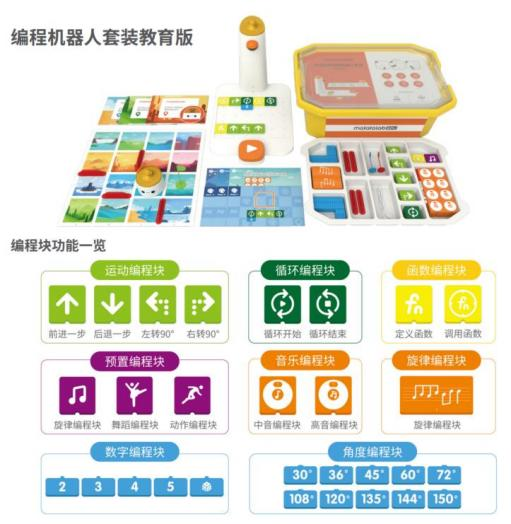
This competition is specifically designed for children aged 4~6 in the middle and senior kindergarten classes, centered around the theme “Space and Interstellar Exploration.” It utilizes the Matata World dedicated educational robotics system, which employs large, safe materials with no small components and features zero-learning curve operation. Through immersive and engaging tasks, the event fosters children’s basic logical thinking, hand-eye coordination, and teamwork skills, embodying the spirit of “joyful participation and courageous exploration.” It serves as an introductory competitive platform for young children in robotics programming.
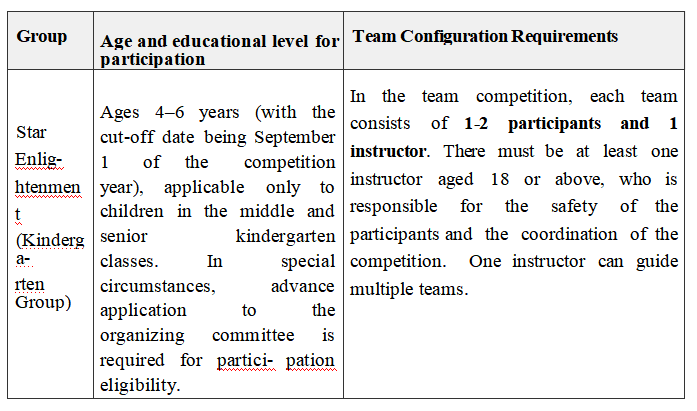
Interstellar Enlightenment (Kindergarten Group): Only officially designated Matata children’ s edition original equipment may be used. These can be decorated with large-grained safety blocks from the same brand.The use of modified materials with potential ingestion risks— such as 3D-printed parts, corrugated paper, clay, or adhesives—is prohibited. All components are made of rounded-edge soft plastic. Robot size specifications: Static dimensions ≤15cm × width ≤15cm; height unrestricted; total weight ≤300g; no sharp edges.
Future Exploration · Lower Grade Group: permite the use of competition-designated building blocks, Lego blocks, corrugated paper, clay, and adhesive
The device prohibits the use of 3D-printed components or metal materials. The static dimensions shall be ≤16 cm in length × ≤16 cm in width, with no height restriction; the unit may extend automatically upon activation. The total weight must not exceed 350 g.
Future Exploration · Advanced Group: The use of competition-designated building blocks, 3D-printed parts, Lego blocks, corrugated paper, lightweight panels, and adhesives is permitted; the use of metal materials and additional power components is prohibited. Static dimensions: length ≤16 cm × width ≤ 16 cm, height unrestricted; the unit may extend automatically upon activation; total weight ≤350 g.
All participants must independently complete robot debugging and motor calibration before the competition. No dedicated calibration time will be provided during the event. Any performance discrepancies resulting from uncalibrated equipment will not be accepted for appeal by the organizers.
The Competition Map Is Made of Eco-Friendly Photo-Realistic Material, With Overall Dimensions of 1800mm × 900mm. The Competition Platform Features an Anti-Slip KT Board.
The ground surface allows minor undulations within 5 mm, ensuring no safety hazards throughout the journey. The exclusive mission area for each team includes: 1 100mm×100mm robot startup zone, 1 energy supply station, 4 energy points, 4 energy receiving points, and 1 300mm×400mm interstellar home construction zone. All props are made of soft rubber with rounded edges: 2 cylindrical energy blocks, 2 cubic energy blocks, 9 large orange construction bricks, and 1 randomly selected
home construction blueprint. 1. Site and Prop Description
The competition map is made of photographic material, with overall dimensions of 2362mm × 1143mm. The playing platform may be constructed from ground, felt cloth, or KT board, allowing minor surface undulations within 10mm. Each team occupies its own half of the field, which includes two 100mm × 100mm robot starting zones, one 300mm × 400mm energy supply center (also serving as an interstellar puzzle assembly area), four energy marker points, four energy demand points, and corresponding obstacles. A mining area is located in the center of the map, containing 15 orange energy blocks (ore) that are contested by both teams. Basic props: Each team’s half contains two cylindrical energy blocks and two cubic energy blocks, placed randomly before the match; one interstellar puzzle assembly blueprint is drawn randomly prior to the game.
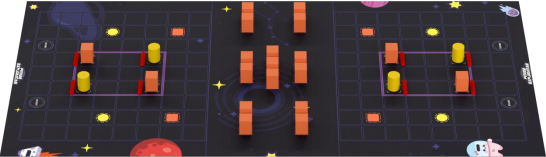
(I) Map and Item Description
1.TheMatchVenue Map Is Printed on Photo Paper, Measuring 2362mm × 1143mm, and Features a Robot Design.
The task area measures 2362 mm × 1143 mm, and competing teams must adapt to minor undulations or wrinkles on the map surface that may reach up to 10 mm in height. During competitions, the stage may consist of ground, felt fabric, or KT board.
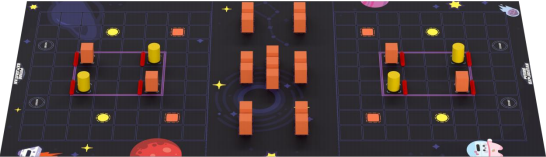 2.EachTeam’s Area Features an Automatic Grid-Based Map Measuring 900mm × 800mm.
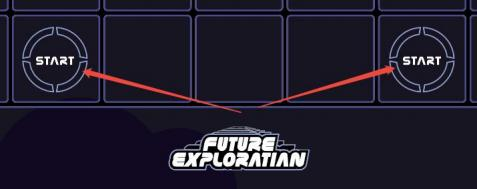
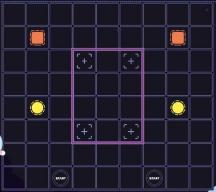 3.EachParty’s Automatic Task Area Contains TwoRobot Startup Zones, With the Following Dimensions: 100mm*100mm
 4.EachSideHas a 300×400 Energy Supply Center in Its Automatic Task Area.
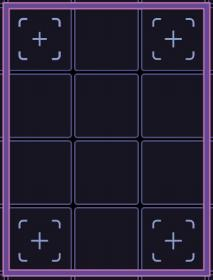 5.TheEnergy Supply Center of BothParties Has Four Designated Energy Monitoring Points.
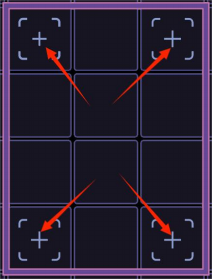 6.The two cylindrical energy blocks andtwocubic energy blocks in the automatic task area of both parties are randomly placed at four designated energy markers. An obstacle is positioned beneath each energy marker.
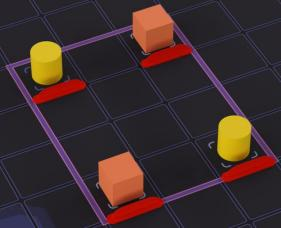 7.Each party’s automated task area contains four energy demand points: two requiring cubic energy and two others.
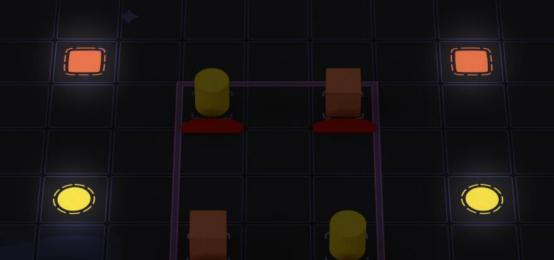 8.TheMap Center Features a 00mm×00mm Mining Area Containing 15 Orange Blocks.
 9.The Energy Supply Center for Mission One Serves as the Assembly Zone for the Interstellar Puzzle Required for Mission Two.
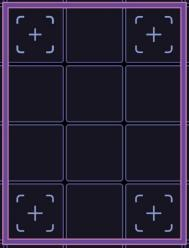
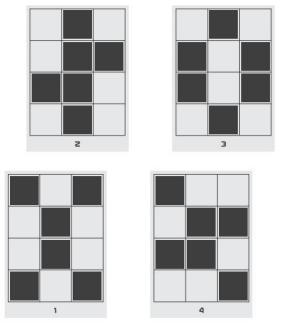
10.The Four Randomly Selected Interstellar Construction Blueprints Before Task 2 Begins Are as Follows:
The competition involves no physical confrontation or cross-team interference; each team completes the task independently within a total duration of 6 minutes, divided into two task phases with a 1-minute debugging break in between.
Task 1: Interstellar Energy Transportation (3 minutes)
Before the competition, the referee announced the placement of energy blocks, allowing participants to plan their programming routes in advance.
The referee announced the start, triggering the timer. The contestants used physical programming to control their robots, launching them from the starting area to deliver energy blocks matching specific shapes to their designated energy collection points.
Scoring rule: For each successfully delivered energy block matching the specified shape (with contact area exceeding 1/2 of the receiving point), 25 points are awarded, out of a maximum of 100 points.
Fault tolerance rules: The robot must complete the entire program before reprogramming and returning to the starting point; minor contact with the field edges or obstacles will not result in penalties. When the robot completely leaves the map, the referee assists in returning it to the starting area without penalty points.
Upon the sound of the task completion whistle, contestants must immediately cease their operations, and the referee records the score.
Task 2: Interstellar Home Construction (3 minutes)
Before the competition, the referee randomly selects construction blueprints for the teams, and participants may review the blueprints during breaks.
After the referee announced the start, the contestants programmed their robots to push the orange building blocks into the designated construction area, placing them precisely into the corresponding cells as specified in the blueprints.
Score rules: For each successfully delivered building block to the construction area, you earn 10 points. For each block precisely placed in the corresponding grid according to the blueprint, you receive an additional 10 points. Maximum score: 180 points.
Rule explanation: Building block pressing or attaching lines does not count toward the accuracy score; extra blocks may be placed anywhere on your side without penalty; if a block is pushed off the map, the referee will retrieve it to its original position without penalty.
Upon the completion signal sounding, contestants must immediately cease operations, and the judges will determine the final score.
Format Description: A points-based ranking system is adopted with no knockout rounds. All teams complete one full match round, and awards are awarded based on total scores to ensure every team’s sense of participation.
Scoring rules: Total competition score = Star Energy Transportation Score + Star Home Construction Score, with a maximum score of 280 points.
Tie-breaking rule: When the total scores are identical, ranking is determined by the time taken to complete Task 1, with the team having the shorter time finishing first.
Prize Distribution: Gold, Silver, and Bronze Awards, along with an Outstanding Participation Award, are awarded based on the total score. All teams that complete the race will receive a completion certificate.
Tie-breaking rule: When total scores are identical, ranking is determined by the time taken to complete Task 1, with the team having the shorter time finishing first (point-based competition). In the elimination round, teams with identical scores play an additional round of Task 2, and the team with the higher score advances.
The complete scoring rules are as follows:
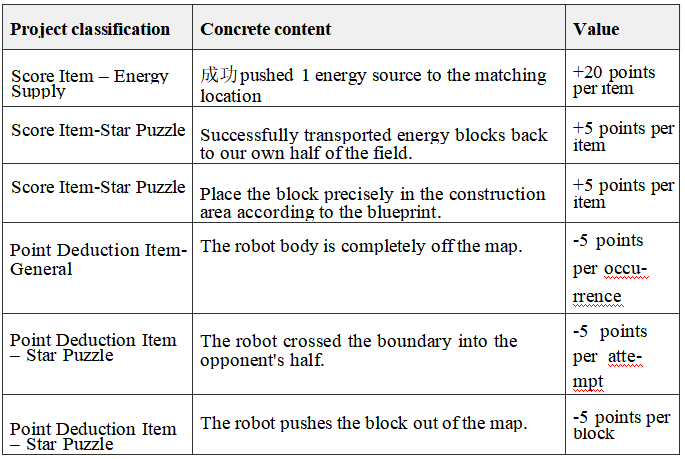
The total competition score = Energy Supply Score + Star Puzzle Score-Total Deductions. All scores and deductions are determined by the judges on the spot and take effect upon the contestants’ signature confirmation.
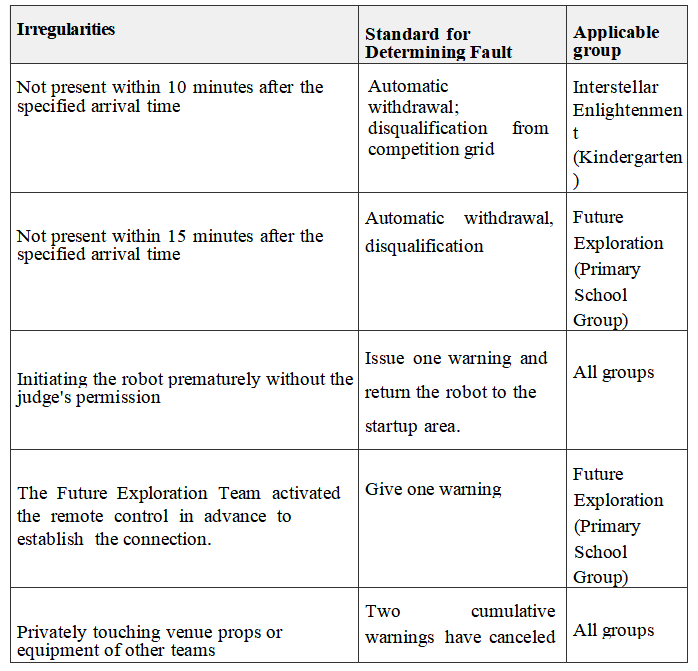
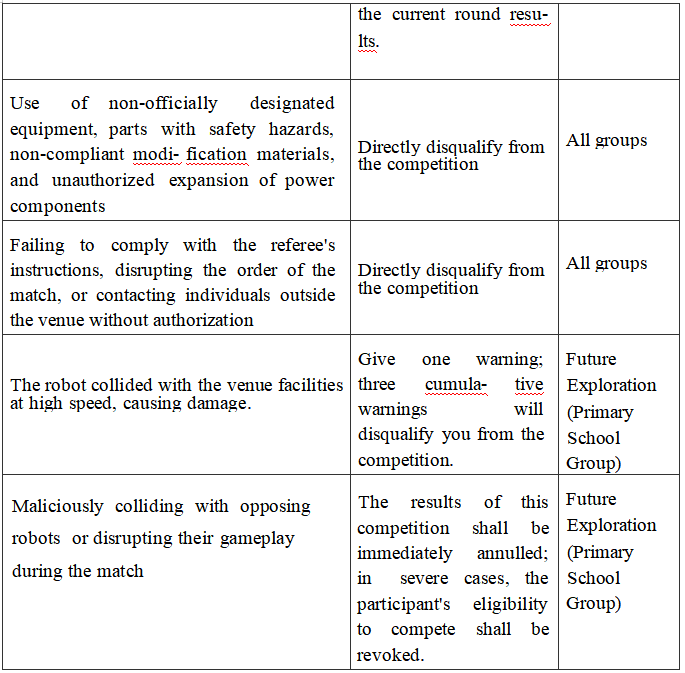
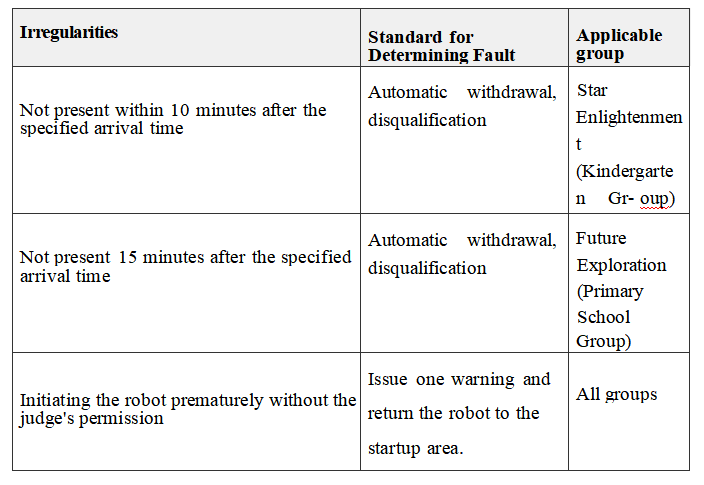
Interstellar Enlightenment (Kindergarten Group): The instructor must present their ID card for registration and receive competition materials. Robot registration must be completed 10 minutes before the event. If the registration fails, corrections must be made within 2 minutes; failure to meet the requirements will result in disqualification from the competition.
The contestant must complete pre-race preparations within one minute and may only begin operations after the referee gives the signal.
Interstellar Enlightenment Group: When a robot malfunctions or falls, it may raise its hand to signal the referee to return it to the starting zone. There is no limit on the number of attempts, and timing continues uninterrupted.
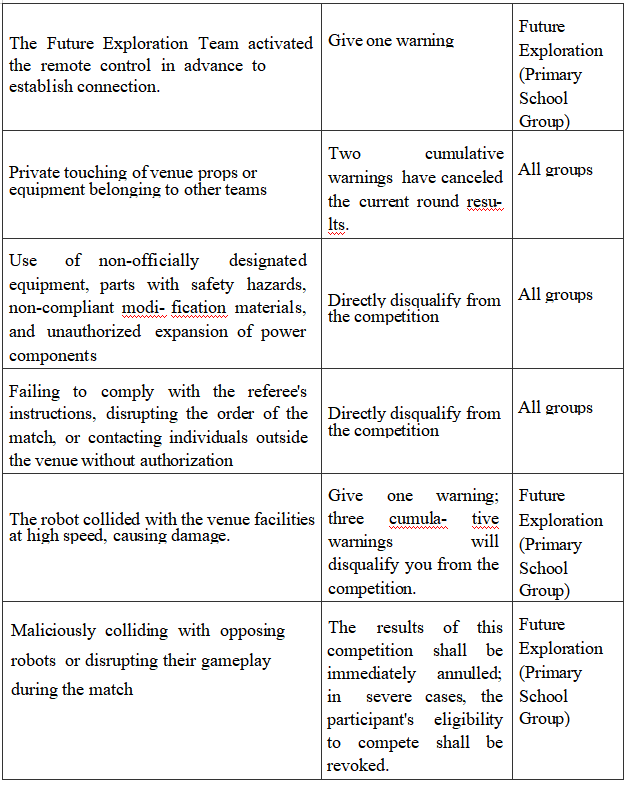
Future Exploration Team: Except for the pause opportunity, unauthorized contact with robots is strictly prohibited. Violators will have their robot disqualified from the competition. Each team is granted one one-minute pause per round for robot maintenance.
The contestants immediately verify and sign to confirm their scores, which become effective upon signing. No appeals will be accepted after the competition. In future evaluations by the judging panel, no video or image materials provided by individuals shall be referenced. Upon completion of verification, contestants must retrieve their equipment and leave the venue in an orderly manner.
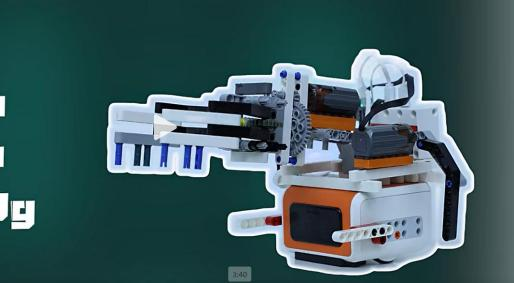
Programming for the Primary School Group
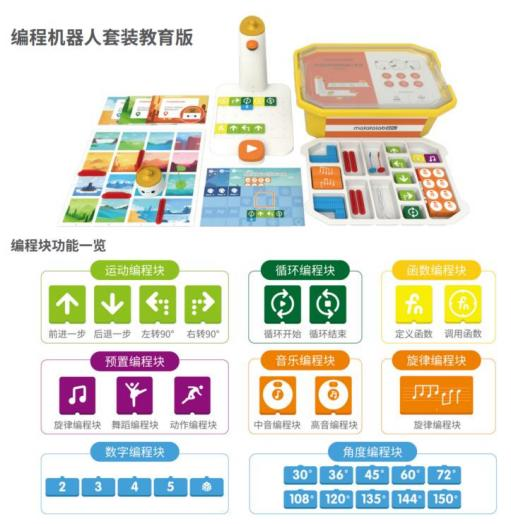
Physical Programming for the Young Children Group
The Matata Robot Challenge features two categories tailored to different age groups, offering programming competitions of varying difficulty levels centered around space themes. Its core objectives are to cultivate fundamental logical thinking skills in young children and enhance comprehensive engineering and programming abilities among school-aged teenagers, embodying the event’s philosophy of “joyful exploration and competitive growth.”
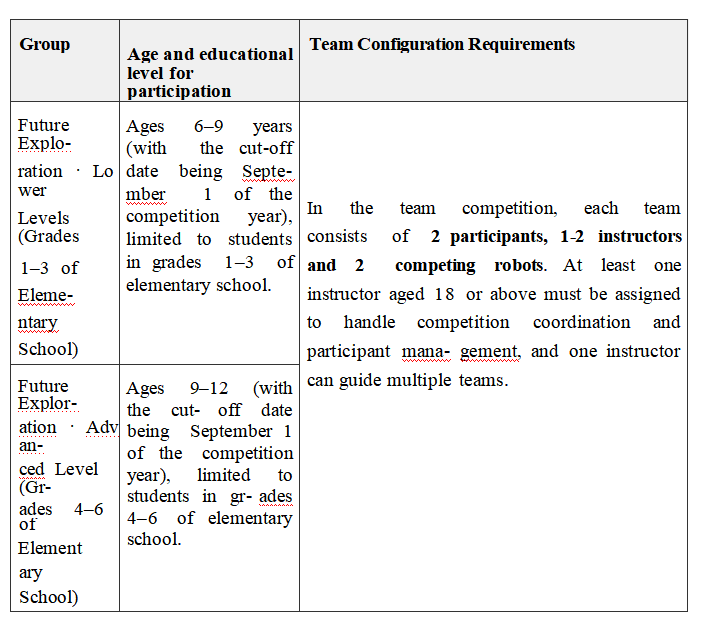
This competition is designed for elementary school students aged 6–12 across all grade levels, centered around the theme of “Space and Interstellar Exploration.” It utilizes the Matata Standard Edition programming robot, which supports both graphical and physical programming modes and is compatible with compliant engineering modifications. Through three core components—automated task execution, robotic system modification, and team strategy competition—the event comprehensively enhances students’ logical programming skills, engineering innovation capabilities, strategic planning abilities, and teamwork skills, establishing itself as a professional robotics programming competition for elementary education. Participants are divided into the Lower Elementary Group (Grades 1–3) and the Upper Elementary Group (Grades 4–6), with competitions held separately within each group.
(I) Competition Team Regulations
Interstellar Enlightenment (Kindergarten Group): Only the official Matata kindergarten edition original equipment specified by the competition is allowed to be used, which can be decorated with large-grained safety blocks ofthe same brand.The use of 3D printed parts, corrugated paper and adhesive is prohibited.
The modified materials (such as soil and adhesives) carry a risk of ingestion. All components are made of rounded soft rubber. Robot dimensions: static length ≤15 cm × width ≤15 cm; height unrestricted; total weight ≤300 g; no sharp edges or corners.
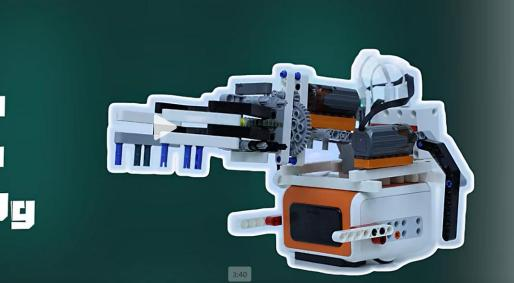
Future Exploration · Lower Age Group: The use of competition-designated building blocks, Lego blocks, corrugated paper, clay, and adhesive is permitted; 3D-printed parts and metal materials are prohibited. Static dimensions: length ≤16 cm × width ≤16 cm, height unrestricted; the unit may extend automatically upon activation; total weight ≤350 g.
Future Exploration · Advanced Group: The use of competition-designated building blocks, 3D-printed parts, Lego blocks, corrugated paper, lightweight panels, and adhesives is permitted; the use of metal materials and additional power components is prohibited. Static dimensions: length ≤16 cm × width ≤ 16 cm, height unrestricted; the unit may extend automatically upon activation; total weight ≤350 g.
All participants must independently complete robot debugging and motor calibration before the competition. No dedicated calibration time will be provided during the event. The organizers will not accept any appeals regarding performance impacts caused by uncalibrated equipment.
1.LocationandProp Description
The competition map is made of photographic material, with overall dimensions of 2362mm × 1143mm. The playing platform may be constructed from ground, felt cloth, or KT board, and the surface is permitted to have minor undulations within 10mm. Each team occupies its own half of the field, which includes two 100mm × 100mm robot starting zones, one 300mm × 400mm energy supply center (also serving as an interstellar puzzle assembly area), four energy marker points, four energy demand points, and corresponding obstacles. A mining zone is located in the center of the map, containing 15 orange energy blocks (ore) that are contested by both teams. Basic props: Each team’s half contains two cylindrical energy blocks and two cubic energy blocks, placed randomly before the match; one interstellar puzzle assembly blueprint is drawn randomly prior to the game.
(I) Map and Item Description
1.TheMatchVenue Map Is Printed on Photo Paper, Measuring 2362mm × 1143mm, and Features a Robot Design.
The task area measures 2362 mm × 1143 mm, and competing teams must adapt to minor undulations or wrinkles on the map surface that may reach up to 10 mm in height. During competitions, the stage may consist of ground, felt fabric, or KT board.
2.Each Team’s Area Features an Automatic Grid-Based
Map Measuring 900mm × 800mm.
3.Each of the Two Automatic Task Zones Has Two Robot Startup Areas, Each Measuring 100mm × 100mm.
4.Each of the Two Automatic Task Areas Contains a 300×400 Energy Supply Center.
5.The Energy Supply Center of Both Parties Has Four Designated Energy Monitoring Points.
6.The two cylindrical energy blocks and two cubic energy blocks in the automatic task area of both parties will be randomly placed at four energy marker points. An obstacle is located beneath each energy marker point.
7.Each party’s automated task area contains four energy demand points: two requiring cubic energy and two others.
8.The Map Center Features a 100mm×100mm Mining Area Containing 15 Orange Blocks.
9.The Energy Supply Center for Mission One Serves as the Assembly Zone for the Interstellar Puzzle Required in Mission Two.
10.The Four Randomly Selected Interstellar Construction Blueprints Before Task 2 Begins Are as Follows:
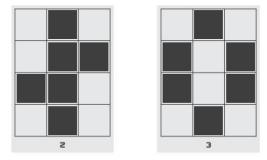
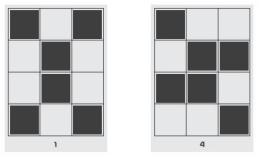 2.Core TaskDescription
The competition features a head-to-head format between two teams, with a total duration (including breaks) of up to 10 minutes. It consists of two task phases, followed by a 2-minute modification and debugging period after Task 1 concludes.
Task 1: Energy Replenishment (3 minutes, 180 seconds)
This task is an independent automated operation performed by a single team, with no confrontation between the two parties and executed synchronously.
Before the competition, the referee announced the placement of energy blocks, and the contestants completed their programming plans in advance.
The referee announced the start, triggering the timer. Each team may control only one physical programming robot to move from the starting area and deliver energy blocks matching the specified shapes to their designated energy demand points.
Core Rules: The robot may only be reprogrammed and returned to the starting point after completing the entire program; timing does not pause. A score is awarded when the energy block contacts the corresponding target point by more than 1/2. If the robot intentionally collides with or moves an obstacle, it must return to the starting point and restart. Minor touches incur no penalty. A 5-point deduction is imposed each time the robot’s main body completely leaves the map, requiring it to return to the starting area and restart.
Scoring rule: For each successfully delivered energy block, you earn 20 points, with a maximum score of 80 points.
When the task completion whistle sounds, contestants must immediately stop their operations. The referee records the score and proceeds to award 2 points.
The watch is in the tuning and debugging phase.
Task 2: Interstellar Puzzle (3 minutes, 180 seconds)
This task involves a head-to-head competition between two teams, with four robots from each team entering the arena simultaneously.
Before the competition, the referee randomly assigns puzzle diagrams to each team, allowing participants to complete robot modifications and strategy planning during the debugging phase.
Upon the referee’s signal, the contestants operated their robots to depart from the starting zone, transport energy blocks to their own half of the field from the mining site, and precisely place them into the designated grids in the construction area as specified in the blueprint.
Core Rules: Each robot may push a maximum of 2 blocks per move; the mine containing 15 blocks may be claimed entirely by either side. Robots may only move within their own half of the map or into the mine; crossing boundaries into the opponent’s half results in a 5-point deduction per occurrence. Blocks that touch or cross the boundary lines do not count toward accuracy scores; excess blocks may be placed anywhere within their own half. Each block pushed off the map incurs a 5-point deduction; any fallen blocks are returned to the mine by the referee. Legal offensive and defensive actions within the mine area are permitted; if robots or blocks are pushed out of the field during combat, no points are deducted, and they are reset by the referee. When a contestant retrieves their robot with the referee’s permission, they must not touch any in-game items or other robots; violators will have their robot disqualified from the current match, and all previously scored points remain valid.
Scoring rules: A block successfully returned to your half scores 5 points; blocks placed precisely according to the blueprint receive an additional 5 points each.
Upon the task completion whistle, contestants must immediately cease operations; scores achieved after the deadline will be invalid.
Competition Format: The first round is a points-based tournament. After all teams complete the points-based round, the 晋 级 spots are determined by the total score ranking, with the advancement rules following the official pre-tournament schedule issued by the organizing committee. Starting from the second round, a single-elimination format is adopted, focusing solely on Task 2, “Star Puzzle,” until the champion, runner-up, and third-place winner are determined. In the elimination rounds, the first-to-score principle applies, with the team scoring higher advancing.
Tie-breaking rule: When total scores are identical, ranking is determined by the time taken to complete Task 1—the team with shorter time ranks higher (point-based competition). In elimination matches, a tie results in an additional round of Task 2, with the higher-scoring team advancing.
The complete scoring rules are as follows:
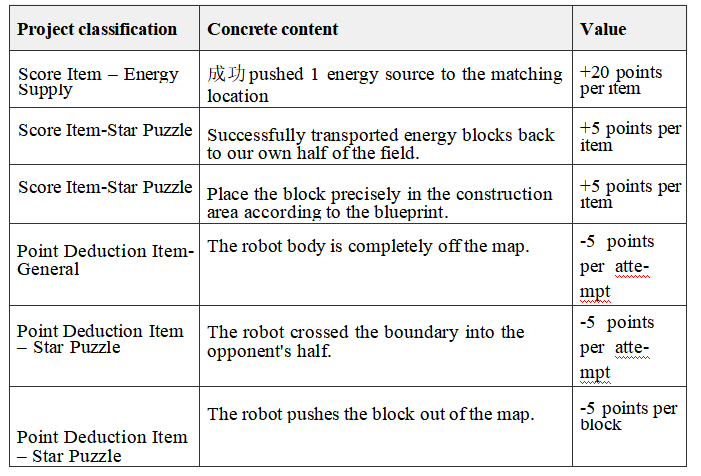
The total competition score = Energy Supply Score + Star Puzzle Score-Total Deductions. All scores and deductions are determined by the judges on the spot and take effect upon the contestants’ signature confirmation.
Future Exploration (Primary School Group): The instructor must arrive at the venue with their ID card to check in and collect competition supplies. Robot registration must be completed 15 minutes before the event, covering equipment compliance, dimensions/weight, and safety standards; non-compliant devices must be rectified within 2 minutes, otherwise participants will not be allowed to compete. Before entering the venue, contestants must hand over their mobile phones, wireless communication devices, and storage media to the instructor for safekeeping; unauthorized entry will result in immediate disqualification. Neither instructors nor parents are permitted to enter the competition site.
The contestant must complete pre-race preparations within one minute and may only begin operations after the referee gives the signal.
Interstellar Enlightenment Group: When a robot malfunctions or falls, it may raise its hand to signal the referee to return it to the starting zone. There is no limit on the number of attempts, and timing continues uninterrupted.
Future Exploration Team: Except for the pause opportunity, unauthorized contact with robots is strictly prohibited. Violators will have their robot disqualified from the competition. Each team is granted one one-minute pause per round for robot maintenance.
The contestants shall verify and sign to confirm their scores on the spot; the scores become effective upon signing. No appeals will be accepted after the competition. In future evaluations, the judges will not refer to any video or image materials provided by individuals. Upon completion of verification, contestants shall retrieve their equipment and leave the venue in an orderly manner.
Programming for the Primary School Group
Physical Programming for the Young Children Group
1.ScoringProcess:Event scoring shall strictly adhere to the standards specified in these rules. Specific scoring details will be supervised on-site by the judging panel and explained in detail during pre-event training.
2. IntellectualProperty: Theintellectual property rights of all entries and related materials belong jointly to the Organizing Committee and the participating teams. The Organizing Committee reserves the right to use outstanding entries for event promotion, exhibitions, and related activities.
3.Specialcircumstances:In case of equipment failures, power outages, or other force majeure events affecting the competition schedule, the organizing committee will adjust the event timeline or procedures accordingly and promptly notify all participating teams.
4. Rule Interpretation: The final interpretation ofthese rules rests with the event organizing committee. For any matters not covered herein, the committee will issue supplementary notices.
5.Contactpersonfor the competition and consultation details: Contact: Teacher Duan/Teacher Su
Contact phone number: 13370153748/18519056855
Contact email:marketing@ttaviation.com
1. Registration Requirements:Eachparticipating team must complete the registration form as required, including the institution name, team name, member names and grades, contact information, as well as the instructor’s name and contact details. All information must be truthful, accurate, and complete without omission.
2.Howtosubmit: Send the completed registration information to the specified email address:marketing@ttaviation.com.
3.RegistrationGuidelines:After submitting your registration information, the organizing committee will review it within the specified timeframe. Upon approval, you will receive confirmation via email or phone call. Applications submitted without required information or with incomplete details will be deemed invalid.
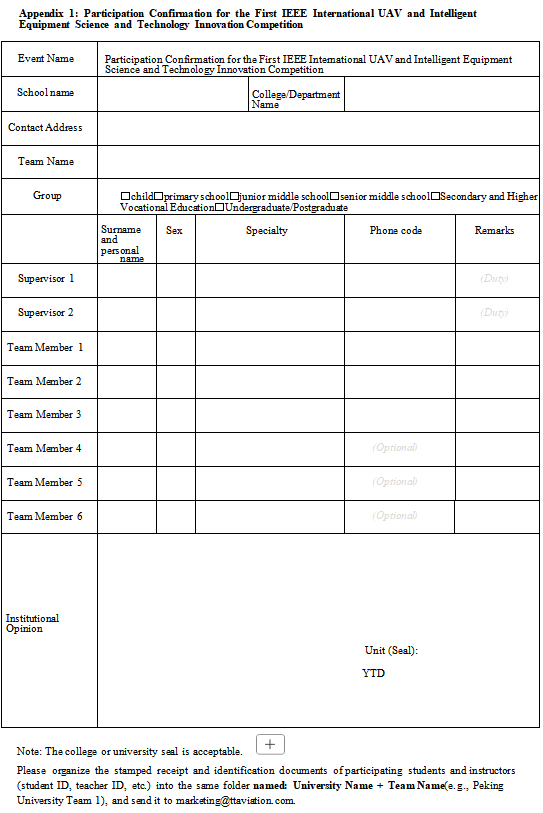
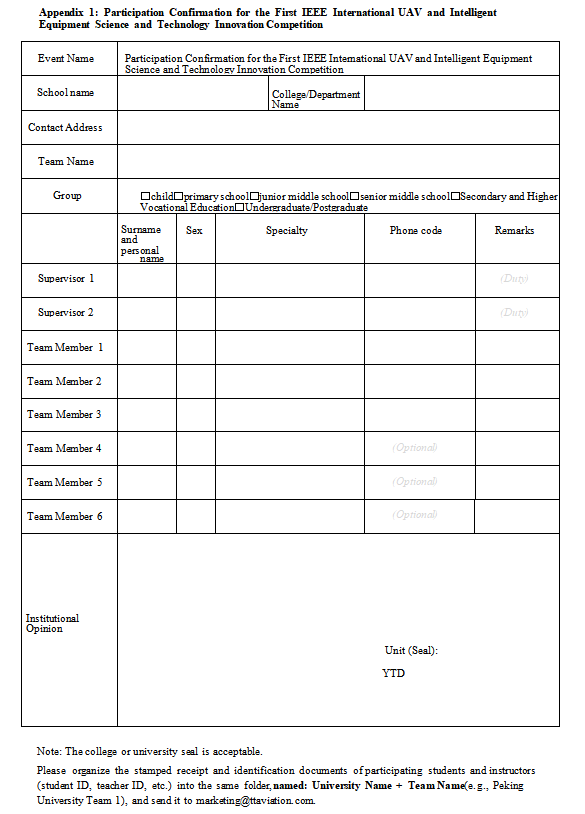
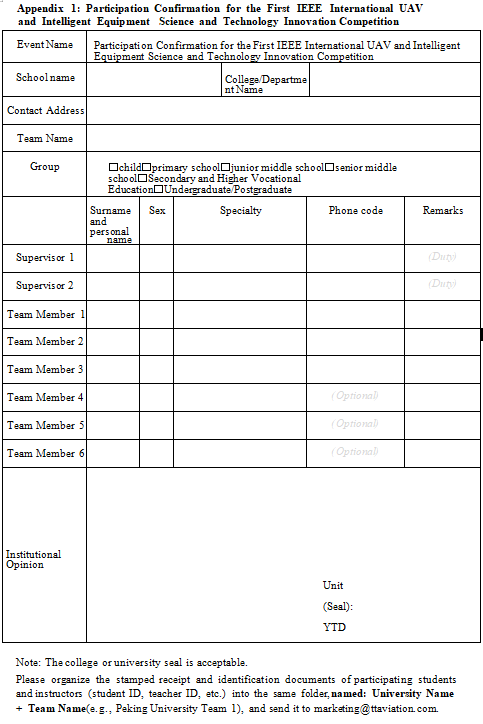
4.The template for the participation receipt is provided in Attachment 1 .
1.EligibleParticipants:Only junior high school students in grades 7–9 are eligible. Registration must be done in teams of 2–6 members, with up to 2 instructors allowed per team (instructors are only responsible for pre-competition guidance and cannot participate in the event).
2.Grouprequirements:Teams must not be formed through unauthorized means,and impersonation or fraudulent practices are strictly prohibited. Any violation will result in immediate disqualification of the entire team and nullification of all competition results. 3.Preparationfor the competition: Participants must bring their student ID card (or campus card) for on-site identity verification; instructors must submit a copy of their teaching credentials in advance for unified review and registration by the competition organizing committee.
1.competition title: UAV Blind Box Surveying and 3D Printing Innovation Design Competition (Junior High School)
2.EventDuration: The entire event lasts 120 minutes (2 hours), including blind box draws, task completion, submission of entries, and on-site presentations. Failure to complete all tasks within the time limit will result in point deductions based on the number of unfinished tasks.
3.CompetitionVenue:The venue is divided into distinct functional zones. The measurement area features standard workbenches; the modeling area is equipped with high- performance computers and licensed modeling software; the 3D printing zone contains multiple high-precision 3D printers and sufficient consumables; and the assembly and debugging area provides dedicated workbenches and manual tools. Participants must complete their tasks within designated zones and are prohibited from moving between areas without authorization.
4.VenueGuidelines:Participants must familiarize themselves in advance with the venue layout and the locations of equipment across all zones. During the event, they must maintain venue cleanliness voluntarily; refrain from moving equipment or consumables without authorization, and avoid chasing, playing rough, or making loud noises within the venue. Violators will have their performance points deducted.
5.Equipmentand Consumables:All measurement tools required for the competition (such as tape measures and calipers), 3D modeling software, 3D printers and consumables, and manual tools (like grinding machines and scissors) shall be provided uniformly by the organizers. Participants are prohibited from bringing their own equipment, pre-made models, finished components, or unauthorized auxiliary tools (e.g., modified software).Such violations will be deemed cheating.
The core requirements of this task are: accurately measure the dimensions of drone components in the blind box, document the data in a standardized manner, and use 3D modeling software to replicate the components at a 1:1 scale, ensuring complete consistency in dimensions, structure, and physical appearance.
1.Blindbox draw:
(1)After the competition begins, each team sends one representative to conduct an on-site draw to determine the order for opening the blind boxes. The teams then draw the basic drone component blind boxes in sequence (including parts such as the arm, shock-absorbing tripod, and battery mount).
(2)After opening the blind box, contestants must immediately inspect whether all components are intact and complete, and sign upon confirmation. If any damaged or missing components are found, they may request a replacement of the blind box once; replacements cannot be exchanged again.
(3)After opening the blind box, contestants must properly store the components. Upon competition completion, they must submit the original components, modeling files, and related materials together. If the original components are lost or damaged, this task will be awarded 0 points. 2. Dimension measurement and parameter recording:
( 1)Measurement requirements: All critical dimensions of the component must be measured comprehensively, including length, width, height, hole diameter, thickness, and groove depth. The measurement error shall not exceed 0.1 mm to ensure accurate data.
(2)Parameter Recording: Use the standardized “Dimension Measurement Record Form” provided by the event organizer to accurately and neatly record measurement items, actual measurement data, the measuring tools used, and the measuring personnel. Do not alter or forge any data. In case of errors, correct them by drawing a horizontal line and sign for confirmation. Severe alterations or falsifications will result in direct point deductions for this task.
(3)Measurement time: It is recommended to complete the measurement and recording within 25 minutes. Participants should improve their efficiency; failure to finish within the time limit will be considered as incomplete for this segment.
( 1) Modeling Software: Only use the officially designated licensed 3D modeling software for the competition (e.g., versions suitable for junior high school students such as SolidWorks or UG). No other software is permitted, and software parameters must not be modified without authorization.
(2) Modeling Requirements: The component’s structure, dimensions, and details (e.g., buckles, mounting holes) must be accurately replicated at a 1:1 scale based strictly on measured data. No significant deviations in shape are permitted; hole positions and dimensions must exactly match the actual measurements, and the original component structure must not be altered arbitrarily.
(3) Modeling Specifications: Model files must be named in the specified format (Format: Institution Name + Team Name + Component Name) and saved in the competition-recommended formats (e.g.,.step,.prt), ensuring the files can be opened and edited properly. Files must be saved promptly during modeling; failure to save them in time resulting in file loss will be the participant’s sole responsibility, and the task will be considered incomplete.
4.Task 1 SubmissionRequirements: Submit the signed and confirmed paper copy of the “Dimension Measurement Record Form” and a fully editable 3D modeling source file. Ensure all files are verified before submission; failure to submit as required will be deemed as incomplete completion of this task.
The core requirements of this task are: to independently design practical expansion accessories and fabricate them using 3D printing; simultaneously, design and manufacture a mounting bracket that ensures precise fit and seamless integration with the components modeled in Task 1, enabling direct installation.
1.Extensioncomponent design:
(1)Design Principle: Expansion accessories must align with the task requirements. The extracted drone components (e.g., battery expansion brackets, compact mounting devices) must be functionally usable; decorative accessories without practical purpose should not be included.
(2)Design Requirements: The expansion component must have a rational structure and simple shape, with dimensions that match the original part without compromising its normal functionality. Additionally, the design must be feasible for 3D printing—avoid overly complex structures that are impractical for printing.
(3)Design Document: Create a paper-based sketch of the extension component, mark key dimensions, design concept and functionality. The sketch should be clear and standardized; all team members must sign for confirmation. Avoid including unnecessary content to save time.
2.Designand fabrication of the fixed bracket:
(1)Design Requirements: The fixed bracket must precisely match the components of Task 1 (including both physical and modeled parts), possess a robust structure, securely connect the expansion component to the original parts, and ensure a seamless, non-loose fit after installation for direct positioning.
(2)Production Requirements: The fixed bracket may be fabricated using 3D printing or the manual materials provided by the event organizers (e.g., plastic sheets, wire, etc.). The fabrication must adhere to standardized procedures, resulting in a clean appearance free from obvious burrs, fractures, or deformations. Excessive polishing or finishing is unnecessary to save time.
(3)Fitting requirements: The gap between the fixed bracket and the original component or extension part must not exceed 0.2 mm. After installation, the assembly should remain stable without shaking or jamming, securely fixing the extension part without affecting the normal operation of the original component.
3.3D printing requirements:
( 1)Print parameters: Use the 3D printer specified by the event and set the default standard parameters (contestants may fine-tune the printing speed and temperature within allowable ranges; record any adjustments made) to ensure print quality.
(2)Final product requirements: The printed expansion components must be complete, free from defects such as missing parts, fractures, warping, or deformation, with a smooth surface and dimensions matching the design drawings to meet installation requirements.
(3)Printing time: 3D printing must be coordinated with other steps, and the printing time should not exceed 30 minutes. If printing fails, only one reprint attempt is allowed, and the reprint must be completed within 10 minutes. Failure to complete within the time limit will be considered a non- compliance in this step, and all printing time will be counted toward the total competition time.
4.Task 2 Submission Requirements: Submit design sketches of the extension components, 3D-printed finished extensions, mounting brackets (自制 or printed), and 3D modeling source files for both extensions and brackets. All submissions must include team information. Submissions not submitted as required will be considered incomplete for this task.
The core requirements of this task are: assemble the original drone components, 3D-printed extensions, and custom-made mounting brackets; adjust gaps between parts to resolve issues such as installation lag and poor fit; and perform a basic structural optimization.
( 1)Assembly sequence: Follow a logical order—first install the original drone components, then the mounting bracket, and finally the 3D-printed extensions. Handle the assembly carefully and according to specifications to avoid damaging either the original components or the printed parts. If any component is damaged, promptly inform the referee, and points will be deducted based on the extent of the damage.
(2) Installation Standards: All components must be properly installed with precise alignment. The mounting brackets shall fit tightly against the original components and expansion modules, without any loosening or displacement, ensuring that the expansion modules function as designed.
2.OptimizeDebugging:
( 1) Key debugging points: Proactively identify installation issues such as excessive gaps, installation lag, poor fit, loose components, or misalignment. Use the tools provided by the event organizers to grind and fine-tune on-site to resolve these problems.
(2)Structural Optimization: While ensuring secure installation and proper functionality, simple optimizations can be applied to the mounting brackets and expansion components—such as deburring and adjusting the fit angle—to achieve more precise installation and enhanced structural stability. The optimization rationale should be documented in the “Assembly and Commissioning Instructions.”
(3) Debugging Requirements: After debugging, the overall structure must be stable, allowing smooth disassembly and assembly without issues such as tilting, easy detachment, or jamming. If severe installation problems persist after debugging, this phase shall be deemed non-compliant.
3.Assembly and Debugging Instructions: Completethestandardized “Assembly and Debugging Instructions” provided by the event organizers, clearly documenting assembly steps, issues identified during debugging, corresponding solutions, and structural optimization considerations. All team members must sign for confirmation. 4. Task 3 Submission Requirements: Submit a fully assembled physical prototype (original components + expansion modules + mounting bracket) along with the signed “Assembly and Commissioning Manual.” During submission, demonstrate the installation process on-site to verify smooth operation and proper functionality of the expansion modules. Failure to submit as required or demonstrate satisfactory results will result in the task being deemed incomplete.
1.Pre-race preparation (10 minutes): Contestants arrive to check in, verify identities, receive competition materials, quickly familiarize themselves with the venue and equipment, and efficiently complete all pre- race preparations.
2.Blindbox draw (10 minutes): Each team sends one representative to quickly draw lots, sequentially open the blind boxes, inspect the components for damage, and begin completing the competition task immediately after signing for confirmation—no delays allowed.
3.Task Execution(80minutes): Contestants must efficiently complete three tasks, with particular emphasis on minimizing the design and printing time for Task 2. Time should be allocated reasonably for each stage, and timing will be recorded uniformly on-site. Points will be deducted for tasks completed beyond the time limit.
4.Submission of Works (10 minutes): Contestants must promptly organize all submitted materials, label them with team information, and submit them to the judging panel for signature confirmation without delay.
5.On-site presentation and Q&A session (10 minutes): Each team shall send one representative to briefly introduce the key highlights of their work, promptly answer the judges’ questions, and deliver an efficient presentation.
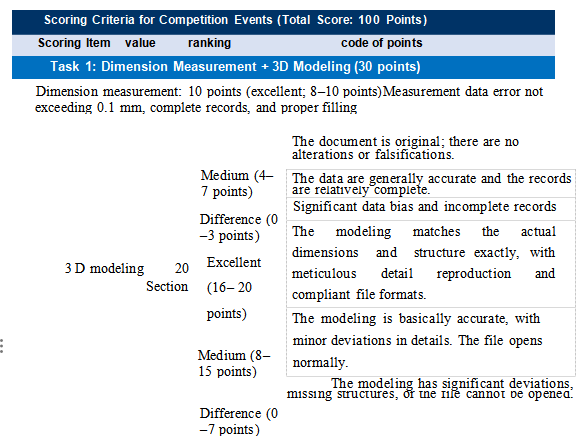
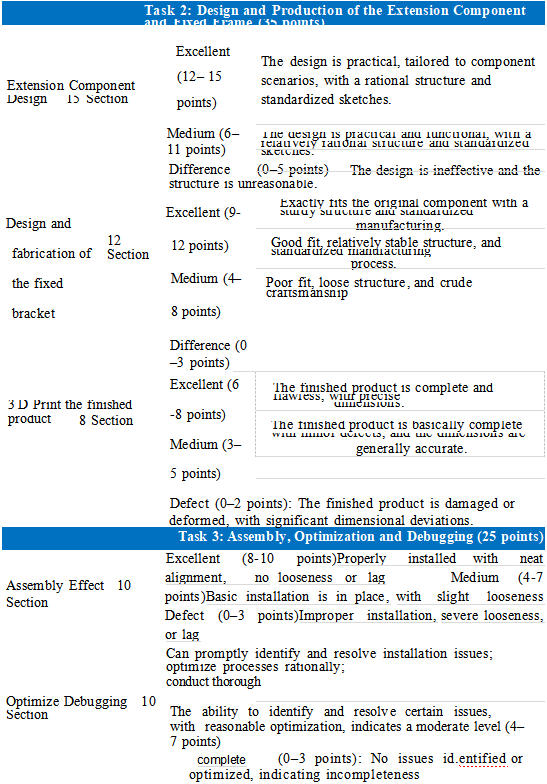
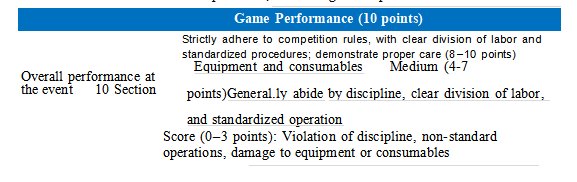
scoring criteria: Primarily evaluates task completion, data accuracy, design rationality, and installation effectiveness The final score is determined by a comprehensive evaluation of the player’s performance on the field, with the specific scoring criteria as follows:
 VI.Competition Disciplineand Handling of Violations
1.During the competition, participants must strictly adhere to venue regulations: maintain silence, refrain from whispering or passing materials, and avoid using others’ measurement data, modeling files, or design plans. Plagiarism and cheating are strictly prohibited.
2.Electronic devices such as mobile phones, USB drives, and tablets are prohibited (except those specified by the event organizers). Pre-made models, finished components, or personal tools must not be brought. Any violation will be deemed cheating, resulting in immediate disqualification of the entire team.
3.Participants must complete all tasks within the specified time limit. Failure to complete tasks on time will result in point deductions for unfinished items. Leaving the venue early without authorization will be considered an automatic withdrawal from the competition, and all tasks will be scored as 0 points.
4.Participants must properly care for competition equipmentand consumables, and adhere to standardized operating procedures. In case of equipment damage or consumable waste caused by improper operation, compensation shall be paid at the original cost, with corresponding performance points deducted from the competition score. Intentional damage to equipment will result in disqualification from the competition.
5.If a contestant disagrees with the referee’s decision, they may submit a written appeal to the competition organizing committee through their instructor. Contestants are prohibited from arguing or causing disturbances with the referee on the spot; failure to comply will result in disqualification.
1.All submitted entries and related materials (including measurement records, design sketches, and modeling files) belong to the competition organizing committee. The committee may display, promote, and archive these works without returning them to the participants.
2.Participants must manage their competition time wisely. If they fail to maintain their own pace and consequently fail to complete the tasks, they bear full responsibility for the outcome.
3.During the competition, in case of unexpected situations such as equipment failure or component damage, immediately raise your hand to request assistance from the referee. Do not attempt to resolve the issue independently, as this will be considered a violation.
4.The organizing committee reserves the final authority to interpret these rules. For any unclear provisions, the committee will issue separate notifications.
5.Contact person for the competition and consultationdetails: Contact: Teacher Duan/Teacher Su
Contact phone number: 13370153748/18519056855
Contact email:marketing@ttaviation.com
1.Registration Requirements: Each participating team must complete the registration form as required, including the institution name, team name, member names and grades, contact information, as well as the instructor’s name and contact details. All information must be truthful, accurate, and complete without omission.
2.How to submit: Send the completed registration information to the specified email address:marketing@ttaviation.com.
3.Registration Guidelines: After submitting the registration information, the organizing committee will review it within the specified timeframe. Upon approval, confirmation will be issued.
Any registration submitted via email or phone that fails to meet the required submission criteria or contains incomplete information will be deemed invalid.
4.The template for theparticipation receipt isprovided in Attachment 1.
1.Participants must be students in grades 10–12 (high school level) and compete as teams of 2– 6 members. Each team may include two instructors (who must be current school staff; they are not permitted to participate in the competition’s performance segment and may only provide pre- competition guidance).
2.Each participant may only join one competing team. Forming teams across different schools is strictly prohibited, as are fraudulent practices such as impersonation or falsification of information. Upon detection, the team’s eligibility to compete and all its results will be immediately revoked.
This competition features only one category for high school students (grades 10–12), focusing on core competencies in drone blind-box mapping and innovative 3D printing design. All participating teams adhere to identical rules and evaluation criteria to ensure fair and impartial competition.
Unmanned Aerial Vehicle (UAV) Blind Box Surveying and 3D Printing for Innovative Design
The total duration of the official competition is 120 minutes (2 hours), with no lunch break, and all tasks must be completed consecutively throughout the event.
1.Surveying equipment: Participants must provide high-precision measuring tools (vernier calipers with an accuracy of no less than 0.02 mm and micrometers with an accuracy of no less than 0.01 mm; a tape measure may be used as an auxiliary tool). The use of automated surveying equipment such as laser scanners is strictly prohibited to ensure the standardization and accuracy of manual surveys.
2.3D modeling software: You may use mainstream 3D modeling software such as SolidWorks, UG, Creo, or Blender (no version restrictions). Ensure the software can export models in both STL and STEP formats, and submit both formats as required.
3.3DPrinting Equipment: The event will provide high-precision 3D printers (precision ≤0.1 mm) and PLA printing materials uniformly; participants are not permitted to bring their own printers or consumables. If special materials such as high-strength PLA are required, they must be obtained at least 3 working days in advance.
A written application must be submitted to the Hina Organizing Committee; usage is permitted only upon approval.
4.Other equipment: Assembly tools (screwdrivers, wrenches, tweezers, etc.) must be provided by the participants themselves and comply with safety regulations. The bringing of sharp, flammable, explosive, or other hazardous items into the competition venue is strictly prohibited.
1.Participants must possess fundamental mechanical surveying and 3D modeling skills, understand the basic structure and assembly principles of drones, and be proficient in operating the selected 3D modeling software to complete model construction and export.
2.Possesses innovative thinking and problem-solving skills, capable of achieving lightweight optimization while maintaining component performance, and able to diagnose and resolve common issues during assembly.
3.Strictly adhere to competition regulations, comply with the arrangements of the organizing committee and referees, diligently complete all tasks, accurately record test data, and refrain from any dishonest practices such as plagiarism or data tampering.
Draw components from the drone’s blind box (e.g., rotor head, folding mechanism, payload bracket, and other complex parts), measure their dimensions accurately, and use 3D software to create the model, ensuring the modeling error remains within specified limits.
1.Measurement Requirements: Complete measurements of key dimensions—including length, width, height, hole diameter, and wall thickness—must be taken for each component. Each key dimension should be measured three times, with the average value used as the final measurement data. A deduction of 10 points will be applied for each missing key dimension that is not measured as required.
2.Precision requirements: The dimensional tolerance between the model and the actual object must be controlled within ±0.1 mm; for special or complex components, the tolerance may be relaxed to ± 0.2 mm (the reason must be specified in the modeling documentation). A deduction of 5 points is applied for each exceedance of 0.01 mm; if the tolerance exceeds 0.3 mm, the task is considered incomplete, and the score for this item is 0.
3.Submission Requirements: Model files in STL or STEP format and the “Surveying Data Record Form ” (using the template provided by the organizing committee) must be submitted within the specified deadline. File names should follow the format: “Team Name-Component Name-Model Format.” Late submissions or improperly named files will result in a deduction of 5–10 points; failure to submit will be considered as incomplete completion of the task, with a score of 0 awarded.
Based on the model developed for Task 1, implement a lightweight design while concurrently drafting structural optimization specifications that clearly outline the optimization rationale, specific design solutions, and the rationale for parameter adjustments.
1.Optimization Requirements: Thelightweight design must balance structural strength. After optimization, the components must pass strength tests, with their pressure-bearing capacity not falling below 80% of that of the original model; otherwise, the optimization is deemed failed and this item receives a score of 0.
2.Lightweight effect: The optimized component’s self-weightmust be reduced by more than 10% compared to the original model; reductions below 10% are considered incomplete optimization.
For the conversion task, the score is 0.
3.Design Specification Requirements: The “Structural Optimization Design Specification” must be logically clear and comprehensively detailed, thoroughly explaining the optimization rationale, specific implementation approaches (e.g., material removal, structural simplification, topological optimization), and the basis for parameter adjustments (e.g., strength verification data, weight comparison data), with a minimum word count of 500 words. Incomplete content, logical inconsistencies, or failure to articulate optimization justification will result in a deduction of 10–30 points; insufficient word count will incur a deduction of 20 points.
Using the high-precision 3D printer provided by the event, we completed the physical printing of the optimized components. Subsequently, we conducted trial assembly and debugging to identify and resolve issues such as assembly clearance deviations, loose structural connections, and insufficient fit, ensuring the components are compatible with the entire drone and can be assembled smoothly.
1.Printing Requirements: Printedcopies must not exhibit obvious defects such as damage, deformation, or interlayer peeling. If defects are found, the participant may request a reprint. The reprint time counts toward the total task duration, with a maximum of two reprints allowed. If defects persist after two reprints, the task is considered incomplete and awarded zero points.
2.Assembling Requirements:Afterassembly, the device must be free from looseness or jamming, with proper fit ensuring perfect compatibility with the standard drone unit provided by the organizing committee. If issues such as looseness or jamming persist despite the judges’ reminders, 10–20 points will be deducted. Failure to complete the assembly will be deemed as incomplete performance, resulting in a score of 0 for this task.
3.OperationalGuidelines: Contestants are strictly prohibited from operating the 3D printer without authorization. Any adjustments to printing parameters must be requested in writing from the organizing committee staff and approved prior to implementation. In cases where unauthorized operation results in equipment damage, the team shall not only compensate at full cost but also have their participation qualification and all competition results revoked.
Conduct comprehensive performance tests covering component self-weight, structural strength, wear resistance, and assembly compatibility. Standardize and organize the test data while maintaining complete records, then compare and analyze the performance improvements in weight, strength, and assembly accuracy before and after optimization.
1.Test Requirements: Complete all tests under the guidance of the referee. Test data must be complete and accurate; any alteration is strictly prohibited. If the test data is incomplete, inaccurate, or tampered with, the task shall be deemed incomplete, resulting in a score of 0 and disqualification from participation.
2.Test items: Thecomponent’s self-weight is measured using an electronic balance with a precision of 0.1 g; structural strength is tested by a pressure tester to determine the maximum load capacity; wear resistance is evaluated using a friction tester to measure the number of friction cycles; and assembly compatibility is assessed on-site by the inspector based on the tightness of assembly and ease of disassembly.
3.Analysis ReportRequirements:Based on the test data, prepare a performance improvement analysis report of no less than 300 words. Clearly compare the performance differences before and after optimization to demonstrate its effectiveness. A deduction of 10–20 points will be applied if the report is not submitted, or if the content is perfunctory or lacks effective comparative analysis.
1.Time requirement: All tasks must be completed within a total of 120 minutes. If all tasks are not finished by the deadline, the unfinished tasks will receive 0 points. For each task exceeding the deadline by up to 10 minutes, 10 points will be deducted; if exceeded by more than 10 minutes, the task will receive 0 points.
2.Integrity Requirements: All submitted materials (model files, record sheets, design descriptions, etc.) must be authentic and complete. Plagiarism or theft of others’ works or data is strictly prohibited. Any violation will result in disqualification from the competition, revocation of all awards, and public reprimand.
3.EquipmentManagement: Participants must properly store their personal equipment. Any loss or damage to equipment shall be the sole responsibility of the participant. If such incidents affect the competition progress, it will be considered the participant’s own fault, and no additional competition time will be granted.
The total duration of the official competition is 120 minutes (2 hours), with all segments proceeding consecutively without a lunch break. The simplified schedule is as follows:
1. Blind box draw (10 minutes): Each team representative draws a drone component blind box (non-replaceable), registers, and immediately begins the task.
2. Task1: High-precisionsurveying and modeling (35 minutes): Complete manual component surveying and 3D modeling, then submit the model file and the Survey Data Record Form as required.
3.Task2:Lightweight Structure Optimization (25 minutes): Complete lightweight design based on modeling, and submit the optimized model file along with the “Structural Optimization Design Specification”.
4. Task3:High-Precision Printing and Assembly (35 minutes): Submit the printed model, complete assembly debugging, and have it inspected and confirmed by the judges.
5.Task4: ComprehensivePerformance Testing (15 minutes): Complete all performance tests, submit the test record form and performance improvement analysis report, and finish all tasks.
The scoring for this competition revolves around four core tasks, with a total score of 100 points. The weight distribution and specific scoring criteria for each task are as follows: Deductions specified in the general rules are directly applied to the corresponding task scores until the full deduction limit is reached.
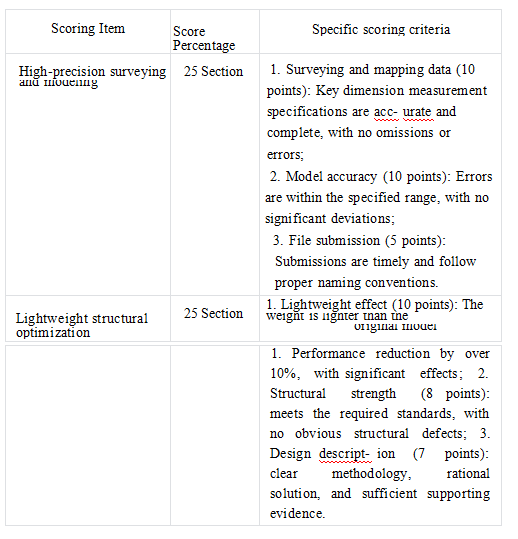
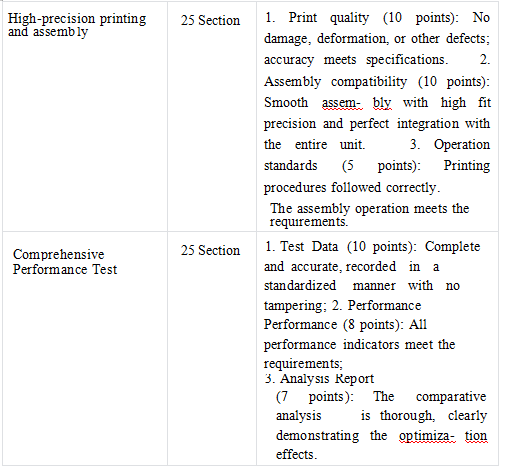
Additional note: In cases of serious violations such as plagiarism, falsification, or equipment damage, all scores will be immediately revoked and the participant will be disqualified from the competition.
1.Check-in and Check-out: Participants must arrive on time for registration; being more than 15minutes late will result in automatic disqualification. Leaving the venue without authorization is prohibited during the competition. If departure is necessary, participants must notify the referees and organizing committee staff and obtain their approval before leaving. The departure time will be counted toward the total competition duration; failure to return within the specified time will be deemed as withdrawal from the competition.
2.EventConduct: During the competition, maintain silence in the venue. No loud talking, whispering, passing equipment or materials, or discussing task-related matters is permitted. Cheating and colluding are strictly prohibited.
3. 申诉Procedure:Comply with the arrangements of the judges and staff. If there are objections to the judges’ decisions, the instructor must submit a written appeal within 30 minutes after completing the task; appeals submitted after this deadline will not be accepted. During the appeal period, participants must continue to complete subsequent tasks without disrupting the competition order.
4.Prohibitedactivities: It is strictly forbidden to bring communication devices such as mobile phones or tablets into the venue (except for computers used for modeling), and it is also prohibited to consult relevant materials or tutorials.
5.Cleanlinessof the venue: Maintain cleanliness at workstations and the competition area; do not dispose of garbage or consumables indiscriminately. After the event, tidy up your workstation.
6.EquipmentManagement: It is strictly prohibited to damage competition venue equipment or materials, or to misappropriate others’ equipment or documents without authorization.
1.Carrying communication devices or consulting materials will result in a deduction of 20 points per occurrence; severe cases will lead to disqualification from the competition.
2.Any actions that disrupt the competition order—such as noise, whispering, or passing items—will result in a deduction of 5–10 points per occurrence; cheating or collusion will lead to disqualification and cancellation of all scores.
3.Damaging competition venue equipment or materials, or misusing others’ equipment or materials without authorization, will result in a deduction of 30 points; in severe cases, the participant will be disqualified from the competition and all results will be nullified, with compensation for the damaged items at full cost.
4.Those who engage in identity theft, falsification, or plagiarism will have their competition eligibility and all results revoked, and will receive a public reprimand.
5.Failure to comply with referees’ or staff arrangements, or disruption of competition order, will result in a deduction of 20–50 points; in severe cases, the participant will be disqualified from the competition.
1.Scoring Process: Event scoring shall strictly adhere to the standards specified in these rules. Specific scoring details will be supervised on-site by the judging panel and explained in detail during pre-event training.
2.Intellectual Property: The intellectual propertyrights of all submitted entries and related materials (including model files, design specifications, test data, etc.) shall be jointly owned by the Organizing Committee and the participating teams. The Organizing Committee reserves the right to utilize outstanding entries for event promotion, exhibitions, and related activities.
3.Special circumstances: In case of equipment failures, power outages, or other force majeure events affecting the competition schedule, the organizing committee will adjust the event timeline or procedures accordingly and promptly notify all participating teams.
4.Rule Interpretation:The final interpretation of these rules rests with the event organizing committee. For any matters not covered herein, the committee will issue supplementary notices.
5.Contactperson for the competition and consultation details: Contact: Teacher Duan/Teacher Su
Contact number: 13370153748/18519056855
Contact email:marketing@ttaviation.com
1.Registration Requirements: Each participatingteam must complete the full registration form as required, including the institution name, team name, member names and grades, contact information, as well as the instructor’s name and contact details. All information must be truthful, accurate, and complete without omission.
2.How to submit: Send the completed registration information to the specified email address:marketing@ttaviation.com.
3.Registration Guidelines: After submitting the registration information, the organizing committee will review it within the specified timeframe. Upon approval, confirmation will be issued.
Any registration submitted via email or phone that fails to meet the required submission criteria or contains incomplete information will be deemed invalid.
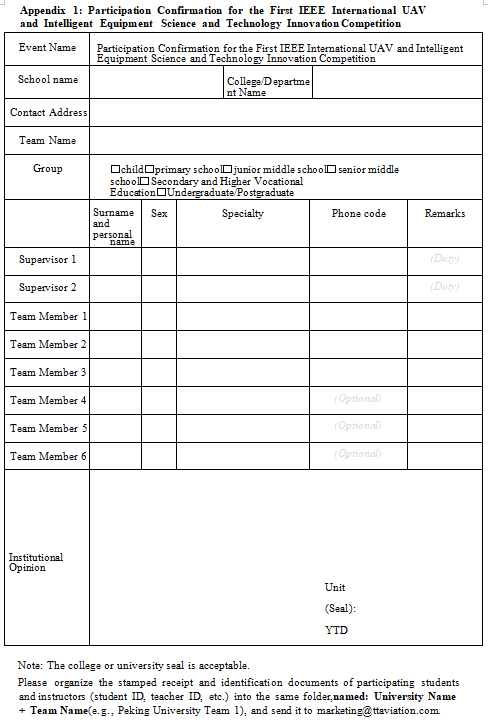
4.The template for theparticipation receipt isprovided in Attachment 1.
1.Eligible Participants:Only current students majoring in relevant disciplines at secondary and higher vocational institutions (including secondary vocational schools and higher vocational colleges) are eligible. Teams must compete in groups of up to six members and may be accompanied by two instructors (who are solely responsible for pre-competition guidance and are not permitted to participate in on-site event operations or supervision).
2.Group participation requirements: Cross-school team formation is strictly prohibited; impersonation, fraudulent practices, and participation by non-students are strictly forbidden. Upon verification, the entire team’s eligibility and all competition results will be immediately revoked.
3.Preparation for theCompetition: Participants must bring their student ID card and ID card (for dual identity verification) for on-site verification; instructors must submit copies of their teaching certificates and institutional recommendation letters in advance for unified review and filing by the competition organizing committee.
4.Skill Requirements:Contestants must possess fundamental drone operation and electronic equipment debugging skills, have a basic understanding of urban infrastructure inspection, and be proficient in operating drone ground stations and related software.
1.Project Title: Intelligent UAV Application Technology for Urban Infrastructure Inspection (Secondary and Higher Vocational Education)
2.Event duration: The total event lasts 180 minutes(3 hours), covering equipment preparation, task completion, project submission, and live demonstration. Failure to complete all tasks within the time limit will result in point deductions for uncompleted items.
3.竞赛venue: A designated competition site divided into four zones—drone installation and adjustment zone, flight path planning zone, flight inspection zone, and fault diagnosis zone. Each zone is equipped with corresponding devices (drones, ground stations, inspection cameras, fault simulation equipment, etc.) and consumables. Participants must complete their assigned tasks within the designated zones and are prohibited from moving between zones without authorization.
4.Equipment and Consumables: The event provides standardized drones (including arms, PTZ heads, inspection cameras), ground station software, remote controllers, batteries, debugging tools, and fault simulation accessories. Participants are strictly prohibited from bringing personal devices, pre-set parameters, or unauthorized auxiliary tools (such as cheating software or external debugging equipment); any violation will be deemed cheating.
5.Site Guidelines: Contestants must familiarize themselves in advance with the venue layout, flight zone boundaries, and obstacle distribution. Operations must strictly occur within designated flight zones; drone activation outside these zones is strictly prohibited, with violators having corresponding points deducted.
1.Follow the operational specifications to assemble and calibrate the drone arm, inspection camera, battery, and gimbal, ensuring all components are securely fastened, installed in the correct sequence, and that the gimbal rotates smoothly without hesitation.
2.Connect to the ground station and complete frequency calibration for the flight controller, IMU, and remote control. Ensure the calibration is successful to guarantee that the drone’s positioning and attitude control meet the basic inspection requirements.
3.Check the aircraft fuselage, inspect all components and communication status; once confirming no looseness or signal abnormalities, instruct the pilot to proceed to the next phase.
1.Plan rectangular comprehensive inspection flight routes for urban infrastructure (bridges, roads) as required, ensuring no areas are missed during inspections, that the route boundaries align with the infrastructure contours, and that obstacles are avoided.
2.Correctly configure the inspection height, camera shooting interval, obstacle avoidance function, and low battery return threshold; enable switching between Chinese and English parameters; ensure reasonable parameter settings; and proceed to the next stage after review by the referee.
1.The drone was manually operated to take off vertically and hover for 20 seconds (maintaining stable attitude) before landing precisely at the designated takeoff and landing point. The operation was standardized, with no significant deviation or collisions observed.
2.Switch to autonomous mode and complete the infrastructure inspection flight along the planned route , avoiding obvious obstacles (guardrails, cables) without collisions or significant deviation from the path. Return to base smoothly after completing the flight.
1.Debug theinspection camera, complete the basic parameter settings, and take test shots until the image is clear and meets the requirements of standard inspection procedures.
2.Conduct autonomous inspection operations to ensure comprehensivecoverage of the designated infrastructure areas, capturing complete images without significant blur or omissions, and enabling identification of obvious infrastructure hazards (such as extensive cracks or damage). Submit the inspection photos along with a hazard identification report.
1.Within 15 minutes, quickly identify and repair the two common simple drone malfunctions preset by the referee (e.g., poor battery contact, camera failure to power on), ensuring the device returns to normal operation and passes the referee’s verification.
2.Simulate a low battery alarm scenario, performing one-click return flight, safe landing, and battery replacement operations with standardized procedures and smooth workflows.
1.Pre-matchpreparation (20 minutes): Contestants arrive for check-in, undergo dual identity verification, receive competition materials and equipment numbers, familiarize themselves with the venue environment, equipment, and rules, and complete equipment startup inspections.
2.Task Execution (140minutes):Contestants complete Tasks 1 through 5 in sequence, allocating time appropriately for each segment with unified timing on-site.
3.Submissionof Materials (15 minutes): Contestants must organize inspection photos, hazard identification forms, flight route documents, and other submitted materials, label team information, and submit them to the judging panel for signature confirmation.
4.On-sitedemonstration and Q&A session (5 minutes): Each team shall send one representative to briefly report on task completion and fault diagnosis.
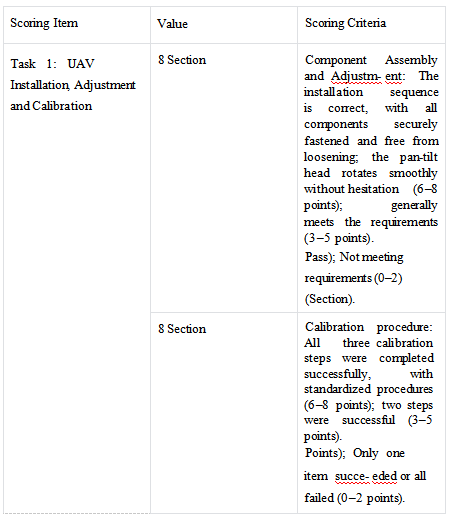
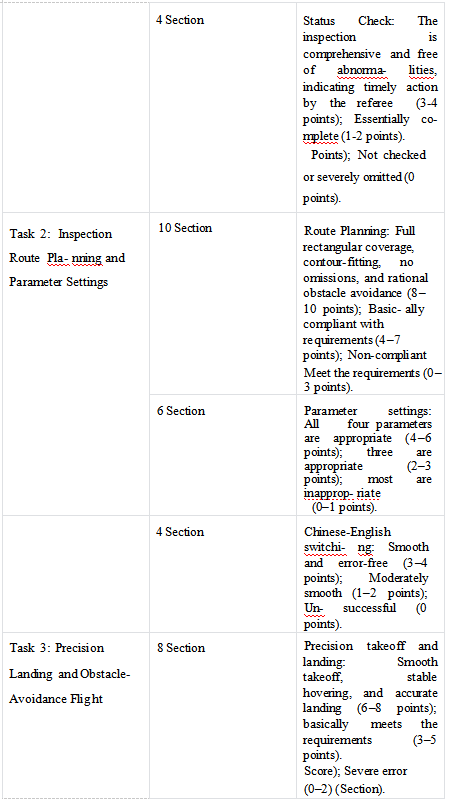
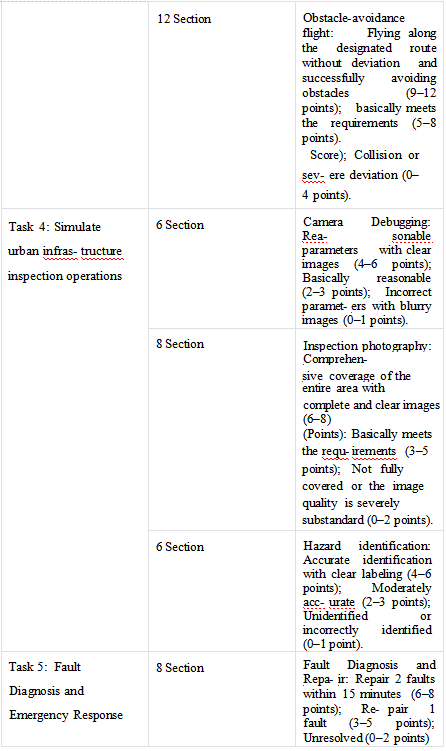
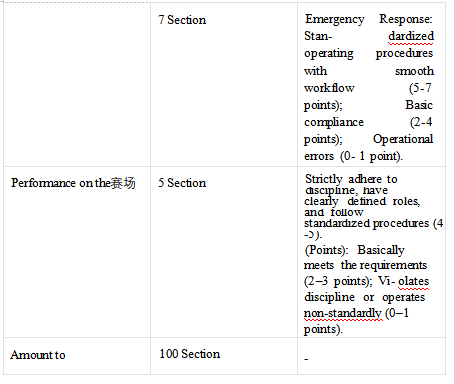
Key Evaluation Criteria: Focused on task completion rate, operational standardization, skill proficiency, and result accuracy, combined with competitive performance.
The comprehensive score is calculated according to the specific evaluation criteria shown in the table below:
1.During the competition, participants must strictly adhere to venue regulations, maintain silence, refrain from whispering, exchanging materials, borrowing others’ equipment or operating procedures, and are strictly prohibited from plagiarism, cheating, or suggesting or assisting other teams in completing tasks.
2.It is strictly prohibited to carry electronic devices such as mobile phones, USB drives, or tablets (except those designated for the event), as well as unauthorized materials like pre-set flight routes, parameter files, or troubleshooting guides. Any violation will be deemed cheating, resulting in immediate disqualification of the entire team.
3.Participants must complete all tasks within the specified time limit. Failure to finish within the allotted time will result in corresponding point deductions for uncompleted items. Early departure without authorization or termination of the competition without permission shall be deemed as automatic withdrawal, with all tasks awarded zero points.
4.Protect competition venue equipment and consumables, and adhere to standardized operating procedures. In case of equipment damage or consumable waste due to improper operation, compensation shall be provided at the original cost, with corresponding venue performance points deducted; malicious damage to equipment or intentional waste of consumables will result in disqualification from the competition.
5.During drone operation, dronesmust strictly operate within designated areas. Flying outside the specified boundaries or violating flight regulations is strictly prohibited; failure to comply will result in deduction of all task points, and severe violations may lead to disqualification from the competition.
6.If aparticipant disagrees with the referee’s decision, they may submit a written appeal to the competition organizing committee through their instructor. It is strictly prohibited for participants to engage in disputes or cause disturbances with referees on-site; failure to comply will result in disqualification from the competition.
1.All submitted entries (inspection photos, hazard identification forms, flight route documents, etc.) belong to the competition organizing committee. The committee reserves the right to display, promote, and archive the entries, and will not return them to the participants.
2.Participants must allocate their competition time reasonably. Failure to complete tasks due to poor pacing or operational errors is not permitted.
The responsibility lies solely with the participant.
3.During the competition, in case of equipment failure or unexpected venue incidents, participants must promptly raise their hands to request assistance from the referee and shall not attempt independent resolution; otherwise, such actions will be deemed a violation. If task completion is impaired due to equipment malfunction, the corresponding task duration may be appropriately extended upon confirmation by the referee.
4.Participants muststrictly adhere to the operational protocols to prevent safety incidents. In the event of safety hazards caused by non-compliant operations, the competition shall be immediately terminated, and relevant parties shall be held accountable.
5.The organizing committee reserves the final authority to interpret these rules. For any matters not covered herein, the committee will issue separate notifications.
6.Contact person for the competition and consultation details: Contact: Teacher Duan/Teacher Su
Contact number: 13370153748/18519056855
Contact email:marketing@ttaviation.com
1.Registration Requirements: Each participating team must complete the full registration form as required, including the institution name, team name, member names and grades, contact information, as well as the instructor’s name and contact details. All information must be truthful, accurate, and complete without omission.
2.How to submit: Send the completed registration information to the specified email address:marketing@ttaviation.com.
3.Registration Guidelines: After submitting your registration information, the organiz- ing committee will review it within the specified timeframe. Upon approval, you will receive confirmation via email or phone call. Applications submitted without required information or with incomplete details will be deemed invalid.
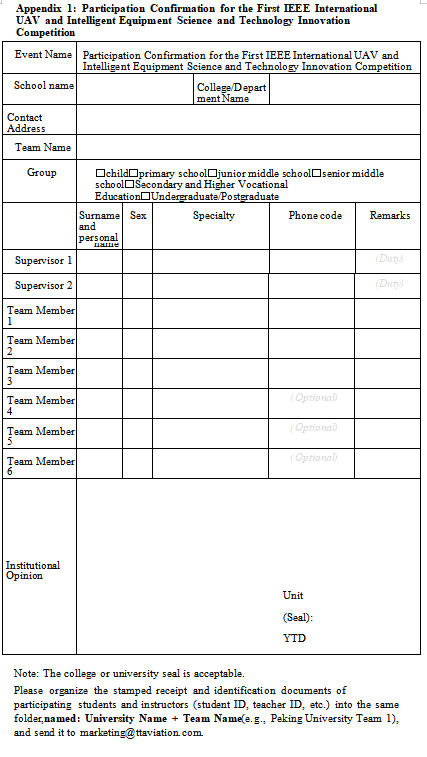
4.The template for the participation receipt is provided in Attachment 1.
1.Participants must be full-time undergraduate students competing in teams of 2 to 6 members. Each team may be accompanied by two instructors (who must be current faculty members), providing only pre-competition guidance and not participating in the actual competition operations, defense sessions, or thesis writing.
2.Each participant may join only one competing team, and each group is limited to one graduate student. Forming teams across universities, impersonation, or fraudulent practices are strictly prohibited. Any violation will result in immediate disqualification of the team and revocation of all its results, along with public reprimand.
3.The participatingteams mustpossess fundamental skills in drone operation, smart device debugging, programming, and scientific research writing, enabling them to independently complete system development, live demonstrations, research reports, and academic papers/abstracts.
This competition features only an undergraduate category, focusing on intelligent unmanned platform technologies for urban infrastructure inspection. The contest covers areas such as smart drone control, additive manufacturing applications in aviation, robotic collaboration, and the Internet of Things. All participating teams adhere to identical rules and evaluation criteria to ensure fairness and impartiality.
Additional Note: Projects from first-prize winning teams will be invited to present their findings as posters during the conference, with the poster content included in the conference proceedings. Projects from other award-winning teams will be publicly displayed on the conference website. All participating teams must submit both a research report and a live demonstration; their submissions are eligible for inclusion in paper abstracts and conference presentations.
Application Technology for Intelligent Unmanned Platform-Based Urban Infrastructure Inspection
The total duration of the official competition is 180 minutes (3 hours), with no lunch break, requiring continuous completion of all tasks and the defense session.
1.Core Equipment: Participants must provide their own drones (including components such as the robotic arm and inspection cameras) and intelligent vehicles (including components such as sensors and communication modules) to ensure stable equipment performance and suitability for urban infrastructure inspection scenarios. The event does not uniformly provide core equipment; only basic power supply, testing venues, and emergency backup materials are provided.
2.Auxiliary equipment: Youmust provide your own inspection camera, positioning module, communication module, batteries (no fewer than 2 sets), debugging tools, and laptop computer (for programming, data processing, and report generation). All equipment must be properly calibrated in advance.
The system operates normally.
3.Software Requirements: Preferred mainstream programming and control software such as Matlab, Python, or ROS is acceptable, with support for Chinese-English language switching. The system must include functional modules for data acquisition, real-time synchronization, and route planning, enabling system calibration, path optimization, and fault diagnosis.
3.Requirements: Preparethe following materials in advance: one paper copy and one electronic copy of the research report; an electronic version of the English academic paper/ abstract; and a preliminary draft of the poster design (electronic version; teams awarded first prize must finalize it on-site). All materials must be submitted in the specified format.
1.Practical Skills: Proficient in drone installation and debugging, intelligent vehicle debugging, and the establishment and operation of air-ground coordination systems. Capable of performing equipment calibration, flight path planning, inspection operations, and emergency response in a standardized manner.
2.Research and Innovation Capability: Capable of conducting innovative designs aligned with competition requirements, optimizing inspection technical solutions, producing research outcomes with academic value, and completing the writing of English academic papers/abstracts.
3.Teamwork and presentation skills: The team has clear division of labor and can efficiently collaborate to complete various tasks; possesses strong communication skills, enabling clear articulation of technical solutions, experimental data, and innovative aspects, while confidently responding to questions from the panel.
4.Integrity Standards: Strictly adhere to competition regulations; submit research reports, experimental data, and academic papers truthfully; and refrain from plagiarism, data fabrication, or any form of misconduct.
1.Assemble and calibrate the drone (including the arm and inspection camera) and the intelligent vehicle (including sensors and communication modules), ensuring all components are securely fastened and functioning properly.
2.Establish a coordinated communication link between open areas, complete the positioning, sensor calibration, and remote control calibration for drones and intelligent vehicles, ensuring stable communication and precise positioning.
3.Conduct a comprehensive inspection of the equipment status; confirm there are no abnormalities and then signal the referee.
Detailed Instructions: 1.Equipment Installation and Calibration: The drone arm must be securely installed without looseness or vibration; the inspection camera should be calibrated for clear imaging and appropriate angle to accurately capture infrastructure details; intelligent vehicle sensors (e.g., LiDAR, cameras) must be properly installed with stable communication module connections to prevent signal interruptions.
2.SystemCalibration: The positioning calibration error must be controlled within ±0.5 m; sensor calibration must ensure accurate data acquisition; remote control calibration must achieve responsive operation with no latency. After establishing the communication link, a 5-minute stability test must be conducted, and only after confirming no disconnections or lagging issues can the next step proceed.
3.InspectionRequirements: Check the equipment’s power supply, wiring, and component connections item by item, and complete the “Equipment Installation and Commissioning Inspection Form.”
(The organizing committee provides a template.) After confirming no abnormalities, raise your hand to signal the referee. Task 2 may only begin after the referee’s approval. If the inspection is not passed, make corrections within 10 minutes; failure to complete corrections by the deadline will be considered as incomplete completion of this task.
1.Design drone aerialinspection routes and intelligent vehicle ground inspection paths to achieve comprehensive coverage of infrastructure areas without blind spots and avoid hazardous zones.
2.Set appropriate inspection parameters for drones and smart vehicles, support Chinese- English switching, and adapt to collaborative inspection scenarios.
Details:
1.Route and Path Planning: Based on the infrastructure inspection area map provided by the event (including hazardous zone markings), the planned route path must cover all inspection points without omission. Hazardous areas (e.g., high-altitude obstacles, waterlogged zones, construction sites) must be explicitly avoided. The route planning should be scientifically sound and rational to minimize inspection time and enhance efficiency.
2.Inspection parameter settings: The drone should be configured with an appropriate flight altitude (adjusted according to the inspection scenario, typically 5–15 m), flight speed (not exceeding 5 m/ s), and photography interval (1–3 s); the intelligent vehicle should be set with an inspection speed (not exceeding 2 m/s) and sensor acquisition frequency, all parameters being flexibly adjustable; the Chinese-English switching function enables one-click switching, featuring a clear interface and user-friendly operation, meeting international academic presentation requirements.
3.Submission Requirements: Upon completion of the planning, save and submit the route/path parameters to the referee system, simultaneously display the planning proposal, explain the planning rationale and measures to avoid hazardous areas, and proceed to the next task after the referee confirms compliance.
1.Manually operate the drone for takeoff, landing, and hovering, while simultaneously controlling the intelligent vehicle to the coordinated starting point, ensuring standardized operations without collisions.
2.Under the autonomous collaborative mode, drones andintelligent vehicles conduct inspections along planned routes, accurately avoiding obstacles without collisions or significant deviations.
Details:
1.Manual operation: The drone must take off and land smoothly without severe shaking or impacts; during hovering, its position must remain stable with a deviation within ±0.3 m and a hovering duration of at least 30 seconds; the intelligent vehicle must be operated steadily to accurately reach the coordinated starting point without crossing boundaries or colliding with obstacles.
2.Autonomous Collaborative Obstacle Avoidance: Upon activation of autonomous mode, the drone and intelligent vehicle operate synchronously along the planned route, continuously detecting surrounding obstacles (e.g., trees, walls, overhead cables) to achieve precise obstacle avoidance with a response time of no more than 1 second. During operation, there are no collisions or significant route deviations (deviation ≤±0.5 m), with seamless coordination and no lag or disconnections.
3.Fault tolerance requirements: If minor deviations or delayed obstacle avoidance occur, participants may manually intervene and make adjustments. No points will be deducted if the subsequent inspection remains unaffected after adjustment. In cases of collision, severe deviation, or equipment failure, the task must be restarted. The restart time counts toward the total duration, with a maximum of one restart allowed; exceeding this limit renders the task incomplete.
1.Debug theinspection equipment to ensure clear images and accurate data, achieving real-time synchronization of aerial and ground data.
2.Conduct coordinated inspections to achieve full regional coverage, accurately identify infrastructure hazards, and complete their precise localization and correlation.
Details:
1.Device Commissioning: The inspection camera footage must be clear, free from blur or lag, and capable of accurately detecting potential hazards such as infrastructure cracks, damage, or loosening; sensor data acquisition must be accurate with errors within permissible limits; aerial and ground data must be synchronized in real time, with images captured by drones and ground data collected by intelligent vehicles transmitted simultaneously to the control terminal without delay or loss.
2.Inspection Operations: Conduct coordinated inspections along the planned routes to ensure comprehensive coverage of all inspection areas without any omissions. Accurately identify infrastructure hazards (e.g., wall cracks, pavement damage, pipeline leaks), determine their locations and correlation, and document the hazard locations, types, and severity levels, along with relevant data (e.g., dimensions and coordinates).
3.Record requirements: During the inspection process, video footage, images, and data records must be fully preserved as supporting materials for research reports and defense presentations. The accuracy rate of hazard detection must be no less than 90%, with a positioning error not exceeding ±1 m; otherwise, corresponding points will be deducted.
1.Simulateemergency scenarios and standardize the completion of return flight, docking, battery replacement, and system restart procedures.
2.Submit the complete research report, complete thelive demonstration, and participate in the panel defense.
Details:
1.Emergency Response: Simulate emergency scenarios (e.g., low battery level in drones, communication interruption, smart vehicle failure), and contestants must perform emergency operations in accordance with standard protocols: When the drone has low battery, it must return to base and land smoothly; When communication is interrupted, the communication module must be restarted or the backup communication method switched; When a smart vehicle fails, the fault must be quickly diagnosed and repaired, or backup equipment replaced; Battery replacement must be performed properly and swiftly, with the replacement time not exceeding 5 minutes; After system restart, the inspection status must be promptly restored to ensure standardized and efficient emergency response.
2.Submission of Results: A complete research report (including technical solutions, experimental data, innovative aspects, conclusions, etc.), an English academic paper/abstract, and inspection data with image records must be submitted. The research report should demonstrate clear logic and comprehensive content, with authentic and reliable experimental data. The academic paper/abstract must comply with IEEE conference guidelines and highlight innovative contributions and academic value.
3.Physical Demonstration and Q&A Session: The physical demonstration must clearly illustrate the entire collaborative site inspection process, including equipment operation, flight path execution, and hazard detection. During the Q&A session (10 minutes, comprising 5 minutes of presentation and 5 minutes of Q&A), participants must clearly explain the technical solution, experimental procedures, innovative aspects, and value of the outcomes, respond confidently to judges’ questions, and provide accurate answers to technical inquiries.
1.Time requirement: All tasks must be completed within a total of 180 minutes. If not all tasks are finished by the deadline, the remaining tasks will be incomplete.
Complete tasks receive 0 points; for individual tasks, deduct 10 points if the timeout is within 10 minutes, and assign 0 points if the timeout exceeds 10 minutes.
2.Integrity Requirements: Research reports, experimental data, and academic papers/abstracts must be truthful and original. Plagiarism, data fabrication, or theft of others’ work is strictly prohibited. Upon detection, the participant will be disqualified from the competition and have all achievements revoked; a public reprimand will be issued, and eligibility for paper publication and presentation will be denied.
3.Equipment Management: Participants must properly store their personal equipment. Any loss or damage to equipment shall be the sole responsibility of the participant. If such incidents affect the competition progress, it will be deemed the participant’s own fault, and no additional competition time will be granted. It is strictly prohibited to misuse others’ equipment or materials without authorization.
4.Academic Requirements: TheEnglish academic paper/abstract must comply with the IEEE conference formatting guidelines, be free of grammatical errors, demonstrate clear innovative contributions, and possess significant academic value; outstanding submissions will be recommended for inclusion in the IEEE conference proceedings.
The total duration of the official competition is 180 minutes (3 hours), with all segments proceeding consecutively without a lunch break. The simplified schedule is as follows (total duration: 180 minutes):
1.Equipment installation and systemcalibration(40 minutes): Complete the installation and debugging of drones and intelligent vehicles, establish communication links, and perform system calibration. Proceed to the next phase after passing the referee’s inspection.
2. Route and route planning(30minutes):Design drone flight paths and intelligent vehicle routes, configure inspection parameters, and submit the plan for approval by the judges before proceeding.
3.Precision Takeoff,Landing,and Obstacle-Avoidance Operation (35 minutes): Complete manual drone takeoff, landing, and hovering, followed by intelligent parking, then initiate autonomous collaborative obstacle-avoidance operation. The judge will score on-site.
4.Coordinated open-areainspection operation(40 minutes): debug and inspect equipment, conduct collaborative inspections, identify infrastructure hazards, determine their locations and establish correlations, and retain relevant records.
5.Emergency Response and Report Submission (20minutes): Complete the simulated emergency operation and submit the research report, English academic paper/abstract, and related materials.
6.Physical Demonstration and Judge’s Review (15 minutes): Complete the physical demonstrat- ion, followed by a review explanation and Q&A session, with judges providing on-site scoring.
Note:Time allocation for each stage is flexible, but the total duration must not exceed 180 minutes. Failure to complete tasks within the time limit will result in point deductions according to the rules.
1.Equipment installation and system calibration (40 minutes): Complete the installation of drones and intelligent vehicles, establish communication links, and perform system calibration. Proceed to the next phase after passing the referee’s inspection.
2.Route and route planning(30minutes):Design drone flight paths and intelligent vehicle routes, configure inspection parameters, submit the plan, and proceed after approval by the judges.
3. PrecisionTakeoff,Landing, and Obstacle-Avoidance Operation (35 minutes): Complete manual drone takeoff, landing, and hovering, followed by intelligent parking, then initiate autonomous collaborative obstacle-avoidance operation. The referee will score on-site.
4. Coordinated open-areainspection operation(40 minutes): debug and inspect equipment, conduct collaborative inspections, identify infrastructure hazards, determine their locations and establish correlations, and retain relevant records.
5. Emergency Response and Report Submission (20minutes): Complete the simulated emergency operation and submit the research report, English academic paper/abstract, and related materials.
6.PhysicalDemonstration and Judge’s Review (15 minutes): Complete the physical demonstrat- ion, followed by a review explanation and Q&A session, with judges providing on-site scoring.
The competition scoring is based on five core tasks, academic achievements, and defense performance, with a total score of 100 points. The weightings and specific scoring criteria are as follows: deduction items specified in the general guidelines are directly applied to the corresponding task scores until the full deduction limit for that task is reached.
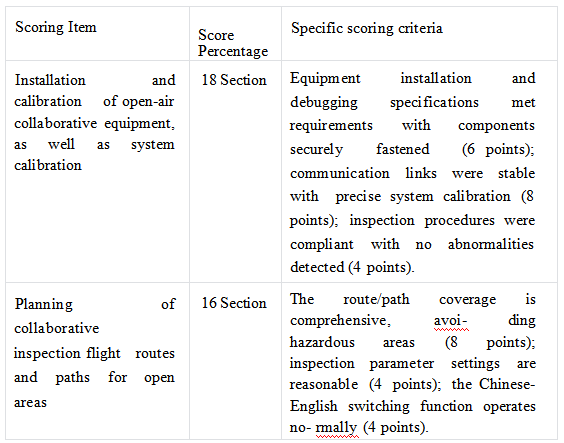
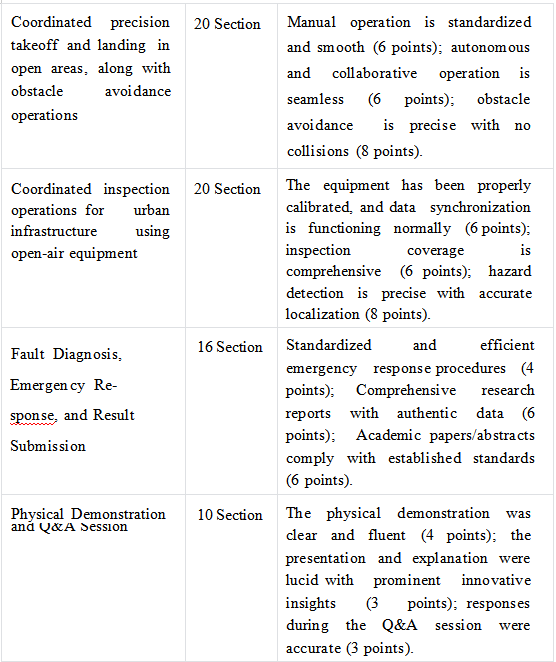
Additional Notes: 1. Teams found guilty of serious violations—such as plagiarism, falsification, equipment damage, or unauthorized use of others’ equipment—will have all scores and competition eligibility revoked immediately; 2. Outstanding academic achievements will be recommended for inclusion in IEEE conference proceedings based on evaluation results; 3. First-prize winning teams must refine their poster designs for presentation at the conference.
1.Check-in and Check-out: Participants must arrive on time for registration; being more than 15 minutes late will result in automatic disqualification. Leaving the venue without authorization is prohibited during the competition. If departure is necessary, participants must notify the referees and organizing committee staff and obtain their approval before leaving. The departure time will be counted toward the total competition duration; failure to return within the specified time will be deemed as withdrawal from the competition.
2.Event Conduct: During the competition, maintain silence in the venue. No loud talking, whispering, passing equipment or materials, or discussing task-related matters is permitted. Cheating and colluding are strictly prohibited.
3.Complain Procedure:Comply with the arrangements of the judges and staff. If there are objections to the judges’ decisions, the instructor must submit a written appeal within 30 minutes after completing the task; appeals submitted after this deadline will not be accepted. During the appeal period, participants must continue to complete subsequent tasks without disrupting the competition order.
4.Prohibited Activities: It is strictly forbidden to bring communication devices such as mobile phones or tablets into the venue (except for laptops used for programming or data processing). Access to relevant materials or tutorials is prohibited. Unauthorized operation of others ‘equipment or alteration of others’ work results is strictly forbidden.
Cleanliness of the venue: Maintain cleanliness at workstations and the competition area; do not dispose of garbage, consumables, or equipment parts indiscriminately. After the event, tidy up your workstation and equipment.
6.Academic Standards:Plagiarism of others’ academic works, tampering with experimental data, and commissioning the writing of research reports or academic papers are strictly prohibited.
1.Carrying communication devices or consulting materials will result in a deduction of 20 points per occurrence; severe cases will lead to disqualification from the competition.
2.Any actions that disrupt the competition order—such as noise, whispering, or passing items—will result in a deduction of 5–10 points per occurrence; cheating or collusion will lead to disqualification and cancellation of all scores.
3.Damaging competition venue facilities or equipment, or unauthorized use of others ‘equipment or materials will result in a deduction of 30 points; in severe cases, the participant’s eligibility and all results will be revoked, and compensation for damaged items shall be paid at full value.
4.Those who commit identity theft, falsification, plagiarism, or data tampering will have their competition eligibility and all results revoked, receive public criticism, lose the qualification for paper publication and presentation, and in severe cases, the matter will be reported to the university authorities.
5.Failure to comply with referees’ or staff arrangements, or disruption of competition order, will result in a deduction of 20–50 points; in severe cases, the participant will be disqualified from the competition.
6.Failure to submit research reports, academicpapers/abstracts, or other achievements in accordance with the specifications will result in a deduction of 10–15 points. Failure to submit such materials shall be deemed as incomplete completion of the corresponding task and will be awarded 0 points.
1.Scoring Process: Event scoring shall be strictly conducted in accordance with the standards specified in these rules. Specific scoring details will be supervised on-site by the judging panel and explained in detail during pre-event training. Scoring results will be announced within 3 working days after the competition concludes, and the list of winners will be published on the official conference website.
2.Academic Achievements: Theposter content of teams awarded theFirst Prize will be included in the conference proceedings, while projects from other award-winning teams will be publicly displayed on the conference official website. Outstanding English academic papers/abstracts will be recommended for inclusion in IEEE conference proceedings, with specific inclusion criteria to be announced separately by the organizing committee.
3.Equipment Support: During the competition, the organizing committee will provide basic power supply, emergency backup equipment, and venue support. Participants are responsible for equipment debugging, maintenance, and fault repair; the committee does not offer equipment repair services.
4.Intellectual Property: The intellectual property rights of submitted entries, research reports, academic papers/abstracts, and related technical achievements shall be jointly owned by the Organizing Committee and the participating teams. The Organizing Committee reserves the right to utilize outstanding achievements for event promotion, academic exchanges, exhibitions, and related activities.
5.Special circumstances: In case of equipment failures, poweroutages, or other force majeure events affecting the competition schedule, the organizing committee will adjust the event timeline or procedures accordingly and promptly notify all participating teams.
6.Rule Interpretation: The final interpretation of these rules rests with the event organizing committee. For any matters not covered herein, the committee will issue supplementary notices.
7.Contact person for the competition and consultationdetails:
Contact: Teacher Duan/Teacher Su
Contact number: 13370153748/18519056855
Contact email:marketing@ttaviation.com
1.Registration Requirements: Each participating team must complete the full registration form as required, including the institution name, team name, member names and grades, contact information, as well as the instructor’s name and contact details. All information must be truthful, accurate, and complete without omission.
2.How to submit: Send the completed registration information to the specified email address:marketing@ttaviation.com.
3.Registration Guidelines: After submitting your registration information, the organizing committee will review it within the specified timeframe. Upon approval, you will receive confirmation via email or phone call. Applications submitted without required information or with incomplete details will be deemed invalid.
4.The template for theparticipation receipt isprovided in Attachment 1.