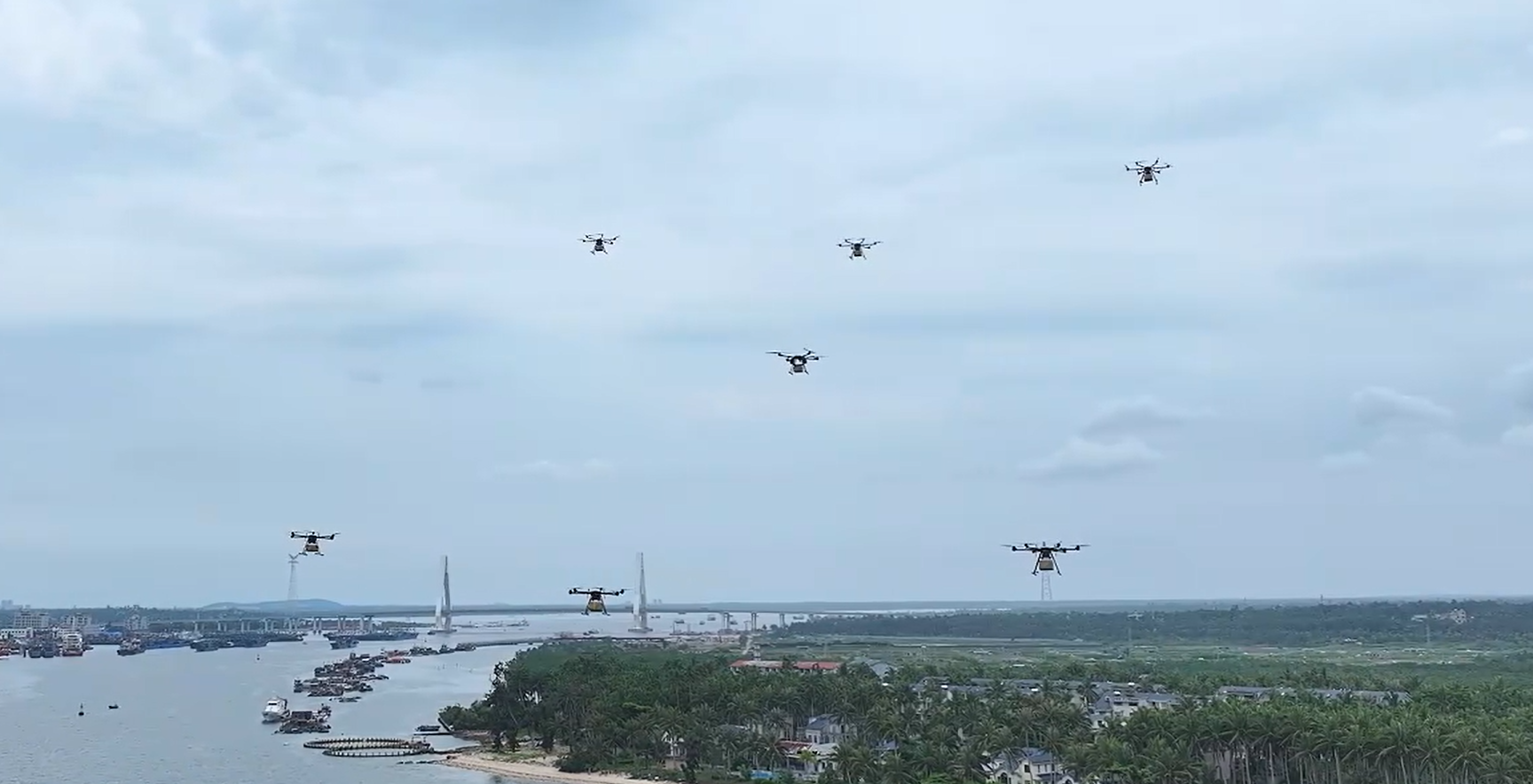
The environment is the crucial variablequantityof the UAV endurance,Different environments cause significant variations in battery endurance by altering factors such as batteryactivity,airresistance,and power load,with overall differences ranging from 20%to 80%.
One,temperature environment:its core influence the battery activity,with differences ranging from 30%to 60% The environment decide the volumn and dischargeefficiency of lithium polymer battery directly,which is the most outstanding factor influencing the endurance.Both high and low temperature can lead to the significantattenuationof endurance,so only the room temperature can maintain the best endurance.
In room temperature environment:(15℃-25℃):The battery exhibits optimal activity,with a discharge capacity reaching 95%-100%of the rated capacity,representing the peak endurance range for drones.Consumer-grade drones can maintain nominal endurance (20-40 minutes)at this temperature,while industrial-grade models achieve stable endurance of 1-2 hours,demonstrating the highest energy conversion efficiency.In high-temperature environments(above 35°C),battery internal resistance increases and thermalrunaway risks escalate.To ensure safety,the battery managementsystem(BMS)restricts dischargepower,reducing capacity to 60%-75%of rated value,while range decreases by 25%-40%compared to conventional conditions.High temperatures also accelerate motor and electroniccontrolsystem(ECS)heating,further increasing energy consumption.The extreme temperatures (above 45°C)may lead to the endurance shrinking over 50%,requiring additional energy for cooling.In low-temperature environments(below 5°C),battery electrolyte viscosity increases and ion migration slows,causing a sharp drop in discharge capacity.At 0°C,range decreases by 30%-40%compared to convention conditions,and at-20°C,the reduction reaches 50%-60%.Some substandard batteries may even fail to start properly.Low temperatures also increase motor starting resistance and power system energy consumption,further compressing range duration.
Second,Wind Speed Environment:Altering air resistance with variations ranging from 20%to 50%.
Wind speed affects air resistance and dynamic load,thereby changing UAV energy consumption intensity. Headwinds and crosswinds significantly reduce flight endurance,while tailwinds slightly improve it;overall differences increase with wind intensity.
Light Wind Conditions (≤Scale 2,wind speed ≤3.4 m/s):Minimal air resistance allows drones to operate without additional power to counteract winddrag.Endurance remains close to nominal values,with fluctuations of less than 5%due only to minor airflow disturbances—this represents the most suitable wind condition for flight. Moderate Wind Conditions (Scale 3–4,wind speed 3.5–7.9 m/s):During headwind flight,increased air resistance requires motors to deliver higher power to maintain attitude and speed,resulting in a 20%–30%rise in energy consumption and a corresponding 20%–25%reduction in endurance.Crosswinds cause drone attitude deviations, needing frequent adjustments in thrust balance,increasing energy use by 15%–20%and reducing endurance by15%–20%.Tailwinds allow drones to harness airflow,saving approximately 10%energy and slightly extending endurance.Strong Wind Conditions (≥Scale 5,wind speed ≥8 m/s):Air resistance doubles,requiring drones to operate at full propulsion capacity to overcome wind resistance.Energy consumption increases by 40%–60% compared to light wind conditions,leading to a 40%–50%reduction in endurance.Some lightweight multi-drones
may even fail to maintain stable flight.Strong winds also intensify air-frame vibrations,further increasing energy loss and reducing battery cycle life.
Third,Terrain Environment:Affects flight attitude and load,with variations ranging from 15%to 40%.
Terrain influences drone climbing/descendingfrequency and powerloadby alteringelevationdifferencesand airflow stability.Battery endurance noticeably decreases in mountainous and urban complex terrains,while remains more stable in flat and open areas.
Flat/Open Terrain:Flat terrain and stable airflow eliminate the need of frequent climbing or descending,allowing constant-speed flight and uniform energy consumption.Endurance approaches nominal values,fluctuating by less than 10%due to minorundulations,making it suitable for long-duration missions.Mountainous/HillyTerrain: Significant elevation changes require frequent altitude adjustments.Energy consumption during climbing is 2–3 times that of level flight.Meanwhile,valleysandslopes often generate turbulence,causing frequent attitude adjustment.Overall energy consumption increases by 30%–40%compared to flat terrain,reducing battery endurance by 30%–35%.Flying along contour lines can reduce some energy use,narrowing the endurance gap to 15%–20%. Urban Complex Terrain:High-rise buildings cause turbulent airflow and signalblockage,requiring drones to frequently avoid obstacles,resulting in frequent acceleration,deceleration,and turning.Energy consumption increases by 20%–30%compared to open terrain,reducing endurance by 20%–25%.Additionally,Building reflection airflow will intensify aircraft vibration,further increasing energy consumption.
Fourth,other weather condition factors:influence endurance indirectly,with difference ranging 10%to 30%.
Environmental factors such as precipitation,light,and humidity indirectly change the endurance capacity by influencing the operationalstatusofequipment.Among them,precipitation and high humidity have the most significant impact,while light mainly affects new energy UAV.
Precipitation environment:In light rain weather,the fuselage gets wet,increasing its weight and resistance.At the same time,the motor and electronic speed controller areproneto moisture,increasing energy consumption by 15% to 20%and the life of battery can be declined by 15%to 20%.Moderate to heavy rain can increase the risk of short circuits in equipment.Most drones are prohibited from flying,and the battery life of some waterproof models will also be reduced by about 30%due to increased resistance.Lighting environment:It only affects solar-assistedpower supplydrones.In strong light conditions,the solar panel’s energy supplement efficiency is high,which can increase the endurance by 10%to 15%.On cloudy days or in the evening when there is insufficient sunlight,the energy supplement fails,and the endurance returns to the basic level.Drones without solar energy functions are minimally affected by sunlight.High-humidity environment (humidity ≥85%):The air density increases,the resistance slightly rises,and at the same time,the battery and motor are prone to moisture and oxidation,the discharge efficiency decreases,and the range is reduced by 10%-15%compared to a dry environment.Long-term flight in a high-humidity environment will also accelerate equipment aging and further reduce the range.
Fifth,Environmental Adaptation Suggestions:Minimize battery Life Differences and Ensure Stable Output. Considering the characteristics of battery life differences in various environments,targeted adjustments can be made to reduce the negative impact of the environment on battery life and ensure operationalrequirements:Temperature Adaptation:Avoidmidday during high temperatures and install a heatdissipation cover on the battery.When the temperature is low,anti-freezing batteries (with anti-freezing electrolyte added)should be used.Preheat the battery before flight to keep the enduranceattenuation within 20%.Wind speed adaptation:Prioritize flying during gentle breeze periods,operate against the wind to shorten the flight path distance,turn on low-power flight mode,and reduce the frequency of attitude adjustment.Try to avoid flying in strong wind conditions.If necessary,choose a compound wing aircraft with strong wind resistance.Terrain adaptation:For mountain operations,routes are planned along contour lines to reduce frequent take-offs and landings.Optimize urban terrain for flight routes,avoid areas with dense high-risebuildings,and reduce energy consumption for obstacle avoidance.